How to prepare for a job in environmental policy? An ACES student shares his experience at Illinois
How do you prepare for a career in environmental policy? Students who want to turn their passion for the environment into a job can find opportunities to gain hands-on experience through internships, research, and advocacy at the University of Illinois Urbana-Champaign.
Brock Bottcher is doing just that. He is majoring in Natural Resources and Environmental Sciences (NRES) in the College of Agricultural, Consumer and Environmental Sciences (ACES). But he is also combining his environmental science education with a second degree in political science to prepare for a career shaping environmental policy.
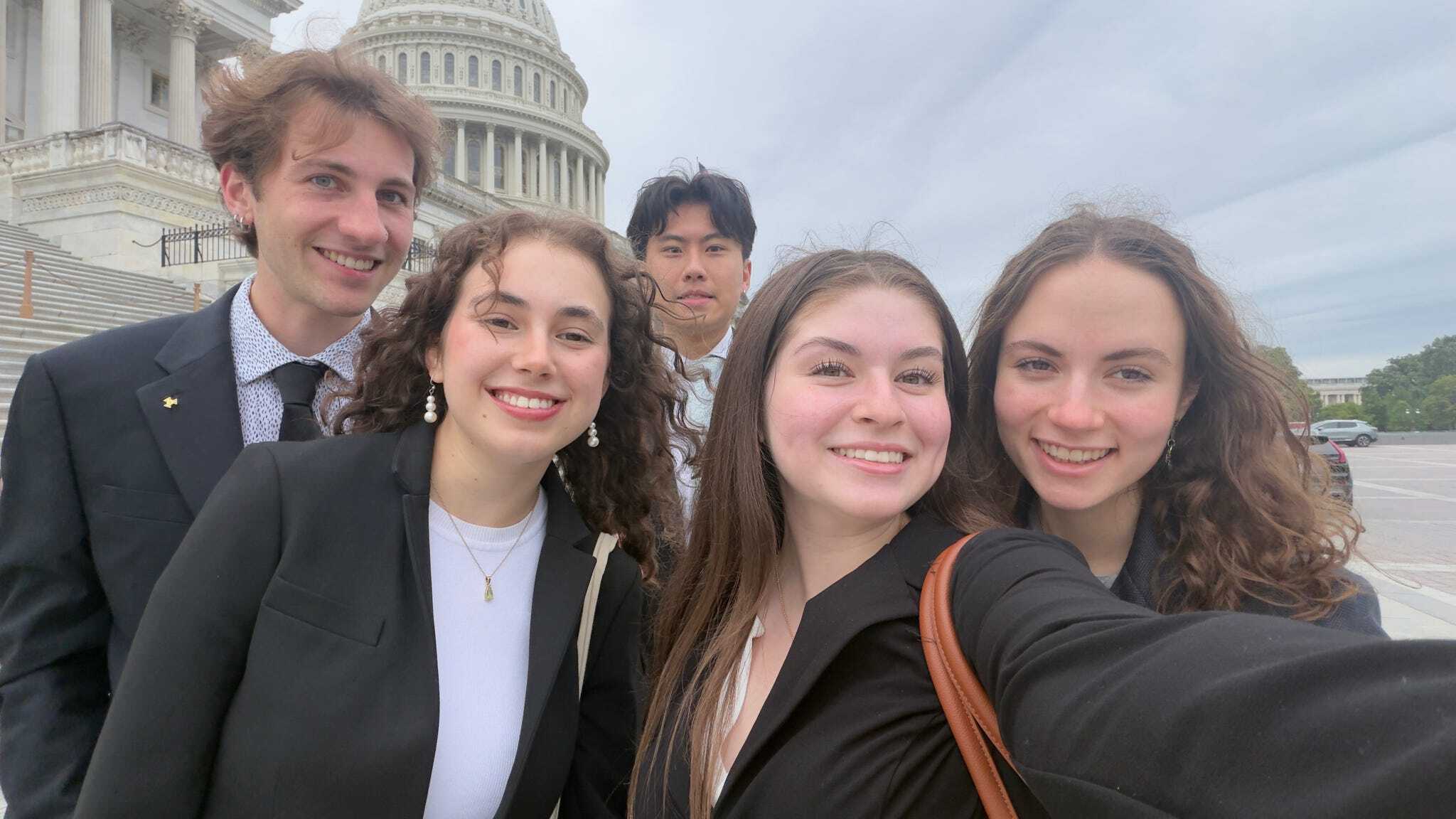
To gain experience in this field, Brock participated in the 2026 Environmental Leadership Program through the university’s Institute for Sustainability, Energy, and Environment (iSEE). The experience took him to Springfield and Washington, D.C., where he met with environmental leaders and policymakers and worked alongside fellow students to advocate for legislation addressing air quality monitoring and the environmental impacts of data centers. This year, Brock returned as an intern to help run the program and provide more students the opportunity to participate.
We caught up with Brock to learn how his NRES education, combined with opportunities across the university, is helping him develop practical skills and work toward making a difference.
Why did you choose to study environmental sciences and political science at the University of Illinois?
I have always loved the environment, and my high school experiences helped me realize that the climate crisis, arguably the defining issue of our generation, is what I would like to dedicate my life to solving.
As my time as an undergrad unfolded, I realized my skills fit best in the social sciences side of environmental sciences. As much as I enjoyed chemistry, biology, soils, and other science classes — and appreciated my time as an undergraduate researcher working with the long grass Miscanthus in the greenhouses and on the farms near campus — I realized that I enjoyed advocating for policy much more, and found my interpersonal skills best able to excel in that field.
That’s why I made the decision last spring to apply for a dual degree in political science. I’m very excited to pursue both majors, using them to advance solutions to environmental issues and stand up for the environment when it doesn’t have a voice.
What is the Environmental Leadership Program, and how does it give students hands-on experience in environmental policy?
The Environmental Leadership Program (ELP) is run by iSEE every spring.
ELP builds students’ research, communication, and advocacy skills, particularly in government, corporate, and environmental contexts. They speak with local representatives to better understand the principles of advocacy and the structure of government. Together, the ELP cohort identifies a specific environmental policy they want to advocate for — at the local or state level — before researching and developing a solution pitch.
The program culminates in a spring break trip to Springfield, where students like me connect with State Representatives and State Senators and convince them to vote for our proposed legislation or amendment. The trip also takes students to Chicago to meet with more organizations, network, and learn more about corporate sustainability and government operations.
Taking part in the program is a phenomenal way to gain hands-on experience in environmental policy. Learning to speak to a variety of different audiences is paramount to an individual’s success in advocacy, and background research not only on a selected issue but also on an organization’s values or a legislator’s district helps students develop advanced communication skills.
Thanks to the ELP’s donors, the program is entirely free of charge! More information can be found on iSEE’s website. For students who participate in the ELP, there is also a newly running D.C. extension in its third cycle this coming spring.
What was it like working with environmental leaders and policymakers in Springfield and Washington, D.C.?
Getting to work and meet leaders in the world of environmental policy in Springfield and D.C. has been the best opportunity of my career! Sometimes it feels hard to be an environmentalist; when the planet’s destruction continues to rage on, it is easy to get discouraged. However, knowing other dedicated fighters are in your corner really helps keep you impassioned.
Additionally, it’s very easy to build connections with these experts. The environmental policy world is tight-knit, and after only about a year of really getting involved, I already feel well-connected to the rest of the movement. Everyone is extremely helpful and kind, and having such intelligent colleagues makes everything easier.
One huge thing I learned by getting to connect with professionals in Springfield and D.C., and through my internships with Illinois’ 103rd House District and the Illinois Environmental Protection Agency, is that advocates perform much better if they obtain in-depth institutional knowledge of how state and federal governments work. Understanding the constraints of laws on specific agencies or bureaus, the resources and competing priorities they fight over, and the stakeholder interests they weigh is essential to passing effective policy.
For example, you can create a bill aiming to protect every remaining natural prairie in Illinois within a year. Still, you need to know who will enforce it, what time, money, and staffing they have available to implement it, what opposition it will face in the General Assembly, and more before it can succeed.
How did you apply what you’ve learned in the classroom to advocating for environmental legislation?
Both the environmental science and the social science side of my curriculum really help out when advocating for environmental legislation.
Having the scientific aptitude to know the topics I’m discussing bolsters my credibility and ensures I can actually speak on the solutions I’m presenting instead of just repeating what I heard others say. It gives me the ability to think through cause-and-effect situations and make real, informed predictions about the implications of the legislation I’m advocating for.
Understanding how to properly communicate and how government structures operate has also been greatly helpful. In scientific communication, there is a theory of communication known as the knowledge-deficit model. This model has been deeply criticized because it assumes an audience doesn’t participate in a certain behavior simply because they lack the scientific knowledge to know the pros and cons of taking part in said behavior. While, yes, it’s important for audiences to understand the science, aligning your messaging with their values works much better.
Research also shows that behavior change might be better achieved not by trying to change the values of your audience, but by convincing them that the action you want them to take aligns with their values or share common interests. Keeping these ideas in mind has really helped me become a better communicator, especially in these 1:1 types of settings.
How have your experiences at Illinois helped prepare you for a career in environmental science or policy?
Generally speaking, the work I do every day here at the university helps me prepare. Research and critical thinking skills — which I develop daily through homework assignments — are essential for policy analysis and formulation. The diversity of thought and students here on campus has really helped me expand my social horizons and understand how to communicate with a variety of people with all sorts of interests!
To get more specific, I owe lots of my growth to iSEE. The opportunity to participate in the 2026 ELP really helped me dive head-first into combining my two disciplines of environmental science and political science.
But the number of opportunities our university provides students is incredible. Taking part in the Jonathan Baldwin Turner Scholar Program in the College of ACES has also helped me develop leadership and problem-solving skills. Engaging with RSOs and taking on leadership positions in my co-ed service fraternity, Alpha Phi Omega, has helped me make tons of friends and apply my skills in different environments, which helps me refine them for professional settings.
What has been the most rewarding part of your experience at Illinois, both inside and outside the classroom?
As much as I can tout the professional experiences I’ve had, I honestly think the most rewarding part of my Illinois experience has been getting to know and making friends with the most dedicated, passionate peers in the world. Everyone here at Illinois has a calling, whether or not they’ve found it yet, and everyone feels so unafraid to chase what they think is right. I couldn’t be more honored to take classes, participate in programs, and be friends with such an incredible student body.
The Friendsgivings, trivia nights, random concerts and parties, slow nights in, day trips, and more I’ve gotten to enjoy with my closest friends have made every experience so incredibly worth it. We all help each other grow, and I know we’ll be able to rely on each other for many years to come. I couldn’t be happier.
Interested in studying environmental science at Illinois?
Explore the Natural Resources and Environmental Sciences major in the College of ACES, where students combine scientific knowledge with hands-on learning to prepare for careers addressing environmental challenges.
You can also learn more about iSEE’s Environmental Leadership Program and opportunities to gain experience in sustainability, public policy, and advocacy.