Image
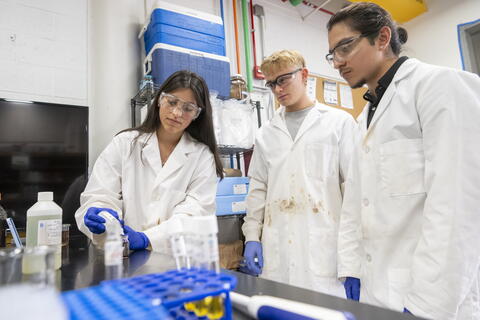
Three ACES students in a lab setting, wearing lab coats and protective goggles.

The College of Agricultural, Consumer & Environmental Sciences is home to more than 10 majors, 19 minors, 20 certificates and countless enriching opportunities that connect academic classes to the world around us.

Your major informs the questions you ask, the kinds of information you work with, and the methods you use for getting answers. Your major will teach you a range of widely transferable skills that you will find relevant in contexts that have nothing to do with your major.

ACES majors fall into a few broad categories:

Agriculture & Environment

  • This area includes improving food security, ensuring a clean water supply, developing climate change solutions, and enhancing the health and sustainability of natural and managed systems. For example (not a comprehensive list): Agricultural and Biological Engineering, Crop Sciences, Natural Resources and Environmental Sciences (NRES)

Data & Technology

  • This involves harnessing big data to advance fields such as agriculture, human and animal health, environmental policy, economics, and technology. For example (not a comprehensive list): Agricultural and Biological Engineering, Computer Science + Crop Sciences, Computer Science + Animal Sciences

Family & Communities

  • This area focuses on educating the public, promoting healthy human development, fostering productive relationships, and addressing societal issues affecting children, families, and communities. For example (not a comprehensive list): Human Development and Family Studies, Agricultural and Consumer Economics (with concentrations like Consumer Economics and Finance), Community Health"

Health & Wellness

  • This includes improving animal and human nutrition, combating diseases, bolstering immune function, and aligning human and environmental health. For example (not a comprehensive list): Food Science and Human Nutrition, Animal Sciences, Dietetics

Many majors fit into more than one of these categories, depending on the research methods used and the questions that are being posed. (For example: Agricultural Leadership, Education & Communications and Engineering Technology and Management for Agricultural Systems).

Related Topics: