ACES professor listening to human voices in AI-centered world
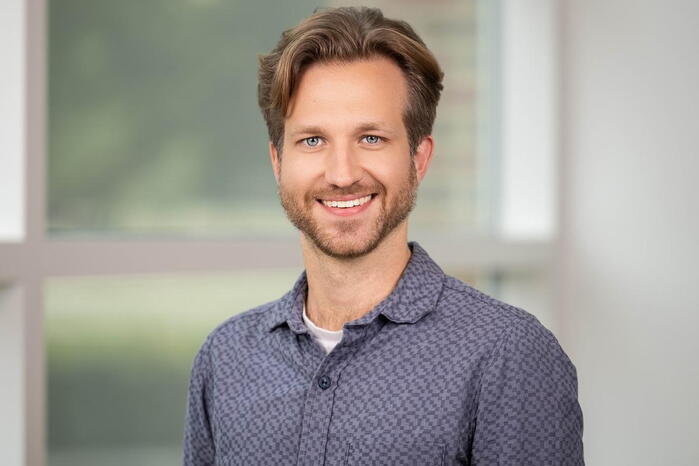
In a world hyperfocused on artificial intelligence, assistant professor Christopher Wirz wants to hear human perspectives on advancing technology. His research in risk and science communication in the College of Agricultural, Consumer & Environmental Sciences at the University of Illinois Urbana-Champaign aims to understand how artificial intelligence tools might be received by those in agricultural and environmental careers.
“How do we go between the decisions people need information for and making sure the science that we have is accurate and able to provide that information? That’s where my research does a lot of work,” said Wirz, who is based in the Department of Agricultural Leadership, Education, and Communications and affiliated with the Department of Natural Resources and Environmental Sciences in ACES. “When we make an AI model, is this actually something that people need, or are they going to feel threatened by it? And how do they make decisions of what tools to use and to trust?”
These questions are a major guiding force behind Wirz’s current research. This past summer, Wirz, also an Illinois Extension Specialist, conducted interviews with farmers across the state to gauge their feelings towards and uses of AI tools. Wirz relayed that while some farmers are clearly more opposed to AI than others, others still are cautiously using these tools to improve agricultural efficiency. “With these interviews, you can start to piece together things that people are worried about or would never want to be done. People across both sides see the benefits and the risks.”
Wirz didn’t start his education intending to focus on risk and science communication. During his undergraduate years at the University of Wisconsin-Madison, he focused on biology and environmental science.
“Science communication was like my third major, something for some life skills on the side,” Wirz laughed. “I had mostly considered science to be in one bucket and communication in the other.”
A senior year seminar on risk communication, however, opened Wirz’s eyes to the interdisciplinary nature of the subject and propelled him into a graduate school career focused on risk communications.
“When I was in undergrad, Ebola was the pandemic we were worried about, which got me wondering why people were freaking out about these well-contained cases. My professor introduced me to a lot of literature on the novelty of risk and how we track people’s responses to risk, and from there I knew I wanted to keep studying this topic.”
After earning his doctorate in mass communication from UW-Madison in 2021, Wirz began conducting postdoctoral research at the National Center for Atmospheric Research in Boulder, Colorado. This marked a shift in his research focus towards studying AI tools and systems, particularly by looking at AI weather and climate modeling tools and how they might be received by users.
Wirz then joined the U. of I. as an assistant professor in 2025 to research ways to support and develop human-centered sciences and technology. His work combines aspects of physical and social sciences for an interdisciplinary approach to agricultural topics.
“Here in the College of ACES, we’re really forerunners in the development of agricultural practices with a focus on biological sciences, and that’s an amazing power,” Wirz noted. “Conducting research here provides a really interesting opportunity to bring together risk and technology communications and apply that to agricultural domains.”
In addition to agricultural applications, Wirz’s recent work also focuses on weather-related AI applications. In collaboration with researchers at the University of Colorado Boulder, a new project looks at how to effectively warn communities about extreme heat events that coincide with poor air quality events using AI models. For this project, Wirz is working with potential users of these models, such as weather forecasters and public health officials, to find what would be more or less helpful in a tool and to better understand how to avoid over-warning or under-warning individuals.
As his work continues, Wirz’s main priority is to find ways for the public to have voices in the sciences. “In science communications, we focus so much on getting information out there, but we don’t talk a lot about listening as academics. If we’ve done our job right on the social sciences side, it should lead to a better informed public to make the decisions that they need for a more human-centered society.”
Building these stronger connections across campus and communities in our state is what draws Wirz to Illinois Extension. “Figuring out ways the research community can more effectively listen and respond to community needs is why I’m really excited to be a part of Illinois Extension. At the end of the day, my work is grounded in the land grant mission, and through that mission I hope to help our communities navigate topics like AI and weather hazards through continued outreach and communication.”