Defining the modern ‘land-grant mission’ at ACES
The College of Agricultural, Consumer and Environmental Sciences at the University of Illinois Urbana-Champaign often cites its land-grant legacy, but the land-grant university system is not a well-known concept outside of higher education. In fact, many current students, staff, and faculty struggle to define it. So, let’s get into what it means, how it came about, and why it still matters.
Today, the land-grant mission centers on three equally important components: education, research, and outreach. While many universities excel in teaching or research — or both — only land-grant institutions are federally mandated to bring the knowledge generated on campuses out to the public. In other words, land-grant institutions don’t lock their discoveries away in an ivory tower. We share useful, science-backed recommendations via University of Illinois Extension staff and volunteers embedded across the state. What’s more, our Extension network informs our research priorities.
How did we get here? The throughline of the land-grant origin story, described below, is access and practicality. Those principles have guided us for more than 150 years, and they’re every bit as relevant today.
Land-grant education: Practical, accessible
The first American universities were strictly open to the wealthiest families, and practical or applied subjects were absent from the curriculum. Young white men of privilege attended to read the classics and debate moral philosophy, graduating to rejoin elite society.
But the Morrill Act, signed July 2, 1862, established colleges specifically to “promote practical education of the industrial classes,” spurring a more egalitarian and solutions-oriented system of higher education.
To pay for these schools, Congress granted quantities of land that could be sold, with the monies invested for their establishment and ongoing maintenance. Eventually, a land-grant institution was established in each state, including the University of Illinois (then called the Illinois Industrial University) in 1867.
The Morrill Act was designed to benefit working people, who demanded more structured educational opportunities in practical disciplines of the time, including agriculture, military science, and engineering.
Today, ACES students come from all walks of life, and our faculty still teach the very latest concepts in agricultural science, as well as in related fields such as food science and human nutrition, environmental science, agricultural engineering, communications, economics, policy, and family studies.
Over time, the college has adapted these core disciplines to prepare students for a wide variety of emerging careers, such as bioengineering, precision fermentation, data analytics, personal finance, hospitality management, teaching, policymaking, and more.
“The Morrill Act was a mandate to provide the highest quality education to all, and we take pride in delivering on that promise,” says Anna Ball, associate dean for academic programs at ACES. “No matter the discipline, our students are educated across four critical pillars — experiential learning, leadership enrichment, global experience, and inclusive intelligence — so that they’re ready to solve real-world challenges with practical solutions."
Land-grant research: Delivering solutions through federal investments
Farmers knew that the 1862 Morrill Act had established a university system to teach agriculture and engineering, but they weren’t yet seeing the fruits of that federal investment. So, farmer cooperatives and advocacy groups formed to put pressure on Washington. They wanted universities to do more than teach agriculture; they wanted evidence-based research to materially improve farming practices. That’s how the Hatch Act of 1887 was born.
The Hatch Act required institutions to create Agricultural Experiment Stations — plots of farmland on or near campus where faculty experimented with various factors to improve farming practices — and promised annual federal appropriations to continue this practical research.
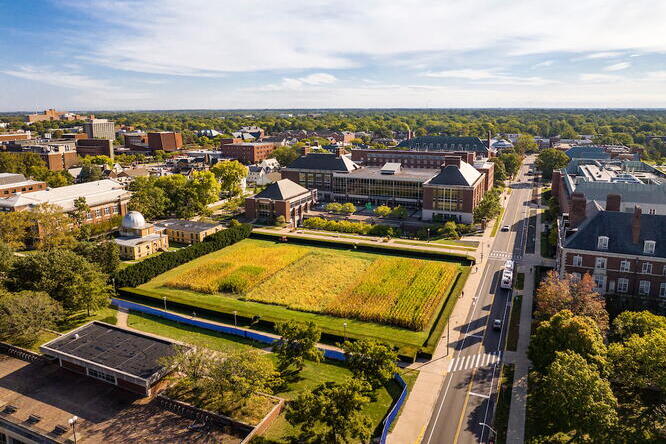
It’s not an exaggeration to say that discoveries from the Illinois Agricultural Experiment Station fundamentally changed agriculture. For example, foundational soil fertility research within the historic Morrow Plots — at 150 years old, the world’s second-oldest continuously running experimental field — demonstrated the promise of manure and crop rotation with legumes to improve yield and soil health. Rotation and fertilizer application are now standard, in every field. Similarly, ACES researchers developed the corn-soy diet, revolutionizing swine nutrition as we know it.
The College of ACES still conducts applied research across its Agricultural Experiment Station — now comprising thousands of acres of farmland across the state, including a working dairy, beef farm, poultry and sheep facilities, the Feed Technology Center, the Sustainable Student Farm, and more — providing solutions for producers and addressing the Hatch Act’s original agricultural focus, all while training students to fill a critical workforce.
In addition to agricultural science, our scope of inquiry has long extended to related fields, such as food science; environmental health; agricultural technologies; consumer behavior; agricultural policy; and human health, nutrition, and development. Today, our researchers define the cutting edge in those fields and many more. What ties our broad research enterprise together is a relentless, solutions-oriented focus that improves lives, industries, and the world we live in.
ACES couldn’t conduct this research or develop practical, science-backed recommendations without governmental support. An important piece of that comes in the form of Hatch funding, appropriated annually via the USDA’s National Institute of Food and Agriculture and matched by state and local funds. To ensure accountability, the Hatch Act requires land grant institutions to provide a stakeholder-informed plan of work as well as annual reports to the USDA, documenting outcomes and impacts of its federal investment.
Although Hatch makes up less than 10% of ACES’ total research budget, it represents a steady stream of funding that sparks innovative projects, fosters interdisciplinary teams, supports infrastructure, and ensures continuity across ACES’ entire research portfolio.
“The Hatch Act and accompanying annual USDA-NIFA support mean we have a responsibility to conduct rigorous, interdisciplinary research that serves the needs of farmers, industry, and the people of Illinois and beyond,” says Rod Johnson, ACES associate dean of research and director of the Illinois Agricultural Experiment Station. “We’re proud to have done that since 1887, and we’ll keep going as long as we’re here.”
Land grant outreach: Translating research to empower communities
By the early 1900s, land-grant institutions were churning out impactful research findings, but results weren’t reliably communicated to rural communities, where farmers struggled with depleted soils, constant pest pressure, and undernourished livestock. Mounting demand for research translation and hands-on training led to the Smith-Lever Act of 1914, which established the nationwide Cooperative Extension System, housed within land-grant institutions.
But Extension isn’t confined to college campuses. Instead, Extension offices and workers operate across every county; in Illinois, 27 multi-county units serve urban, suburban, and rural communities in every corner of the state. Nor are Extension’s offerings restricted to the latest agricultural practices. Instead, Extension shares practical, research-backed information around nutrition and wellness, workforce readiness, gardening and environmental stewardship, parenting, personal finance, and more. Extension also administers 4-H, America’s largest youth development program.
In addition to delivering information, Extension staff also perform another critical function: listening. Because Extension staff are deeply embedded in every Illinois county, they are intimately aware of the challenges their neighbors face. They feed that information back to ACES faculty, who can then design research-based solutions.
This reciprocal system is reinforced by the Illinois ACES Land Grant Initiative, a unique competitive grant program that integrates grassroots insights from Extension with solutions-focused ACES research.
“The Smith-Lever Act and accompanying federal support established our mission to deeply engage with communities and stakeholders across the state, disseminating practical and impactful research-based tools to improve lives and livelihoods,” says Matthew Vann, associate dean and director of Extension and outreach. “Today, that culture is really ingrained in everything we do in ACES.”
Extension is also supported by annual USDA-NIFA appropriations. Like Hatch, Smith-Lever funds require a one-to-one match from state and local governments, as well as planning and reporting requirements. This funding and reporting structure helps ensure Extension's programs and activity are relevant and accountable across each scale.
ACES’ enduring land-grant mission
In 1862, Congress set in motion one of the most consequential societal movements in American history. With a series of laws enacted over the following decades, Congress changed who could access higher education, enabled scientific discoveries that directly affect each of us, and established an army of helpers who inform and respond to communities in every county in America.
“The advancements set in motion by the Morrill, Hatch, and Smith-Lever Acts can’t be overstated,” said ACES Dean Germán Bollero. “More than 160 years later, land-grant institutions like the University of Illinois remain committed to the principles at our foundation. Our mission is more important than ever, and it’s not going anywhere.”