ACES alumna employs biotech to create sustainable livestock production
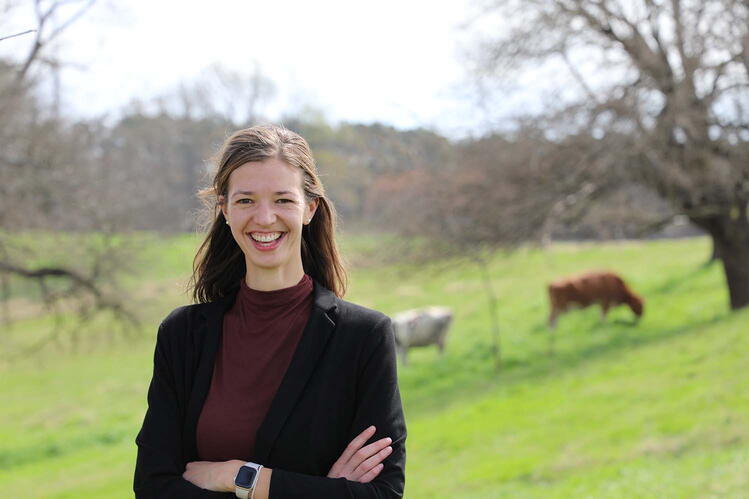
Kathryn Polkoff, University of Illinois Urbana-Champaign alumna, entrepreneur, and scientist, is on a mission to reduce methane emissions from cattle and create more sustainable livestock production.
Polkoff is co-founder and CEO of Hoofprint Biome, a startup biotech company that develops enzymes to improve digestive health in cows. She is the recipient of a 2026 Young Alumni Award from the University of Illinois Alumni Association.
Polkoff, who grew up in Wilmette, began her career path as an undergraduate student in the Department of Animal Sciences, part of the College of Agricultural, Consumer and Environmental Sciences at Illinois.
She initially considered becoming a large-animal veterinarian, but then she got a job working for Animal Sciences Professor Matthew Wheeler’s research lab.
“That was my first exposure to biotechnology, and it quite honestly blew my mind. There were so many things you could do that I had never even been exposed to, or I hadn't even fathomed before. Dr. Wheeler collaborated with other labs across campus, and I learned that whether it's in animal science or biomedical, there are tons of ways you can use biotechnology to make the world a better place,” Polkoff said.
She graduated with her bachelor’s degree in 2015 (after just three years in the program), then continued as a master’s student with Wheeler. Her research focused on using CRISPR technology for gene editing on beef and dairy cattle to improve genetic defects, increase milk yield, or adapt to tropical climates.
She also found time to be a star athlete, competing as a middle blocker for the U. of I. volleyball team throughout her college career.
“Volleyball was another pillar of the experience that shaped who I was. I learned a lot of lessons I wouldn’t have gotten in the classroom, about leadership and communication, as well as discipline,” she said.
After receiving her master’s degree in 2017, Polkoff went on to get a doctoral degree in Veterinary Biomedical Sciences from North Carolina State University. She teamed up with a fellow Ph.D. student to found Hoofprint Biome.
“My co-founder, Scott Collins, had also been working on gene editing, as well as enzyme and microbiome engineering. We had this convergence of expertise where we combined our deep knowledge of both livestock production and the microbiome,” she said.
“We founded Hoofprint because methane from cattle is extraordinarily dependent on the microbiome in the gut. The mission of the company is to cut emissions from cattle while making livestock production more efficient and profitable. We discovered enzymes that eliminate methane and reshape the microbiome to be more beneficial for the cow,” she explained.
Polkoff and Collins secured funding from investors to support a research and development facility, and they are currently employing 12 people. They are scaling production of these natural enzymes and probiotics through yeast fermentation, aiming to deliver them as a feed additive that will improve digestive health and feed efficiency in cattle.
“Our goal is to deliver these products to every cow in the world, ultimately advancing sustainable cattle production globally,” she said.
Polkoff credits her experiences at Illinois with getting her started on this trajectory.
“At Illinois, I spent a lot of time thinking about how we could use biotechnology to improve livestock production, and that's the core of what I’m doing now. What I love the most about Illinois is that there's so much opportunity and so many smart people,” she said.
Her advice for students who are just starting to find their way?
“All you can do is say yes to new opportunities and let go of what you don’t love. You never know what is going to be presented to you. If I had said no to trying out research because I was set on vet school, I wouldn’t have had the opportunities to grow and learn,” she said.
“Likewise, when I was doing my Ph.D. at NCSU, I thought I wanted to be a professor. My co-founder suggested that we start this company. At first, I thought that sounded crazy, but then we created the mission of Hoofprint Biome from the ground up, which has been such a cool and unique experience. But if I had just been focused on becoming a professor, I might not have been open to it.”