Applying ammonia in the spring can reduce risk, Illinois study finds
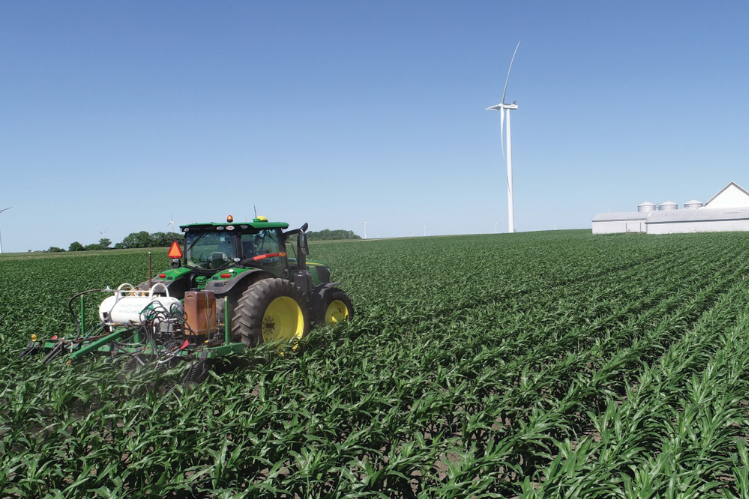
Following recommended practices for fall anhydrous ammonia does not appear to reduce yields compared with spring application, according to new University of Illinois Urbana-Champaign research. However, moving ammonia to spring may require less nitrogen to reach the same economic goal.
Researchers compared fall- and spring-applied ammonia in 19 field trials across Central Illinois from 2013 through 2020. Importantly, the trials followed recommended fall management: ammonia was applied when soil temperatures were at or below 50 F, and every fall treatment included a nitrification inhibitor.
At 16 of the 19 sites, corn responded similarly regardless of timing. At the other three, spring application performed better — primarily by reducing the nitrogen rate needed to optimize economic return.
“The crop response is very similar at almost every site, 16 of the 19,” said lead author Blake Link, a graduate student researcher in the Department of Crop Sciences, part of the College of Agricultural, Consumer and Environmental Sciences at Illinois. “But in the other three, the response is significantly different between the two application timings.”
Across all 19 sites, the economic optimum nitrogen rate, or EONR, averaged 174 pounds of N per acre with fall ammonia and 160 pounds with spring ammonia. Yields at those rates were nearly identical, and the difference in economic return was not statistically significant.
“On average, you can use less nitrogen fertilizer applied as anhydrous ammonia if you apply it in the spring,” Link said. “But that's caveated by saying, oftentimes it wasn't the case that that was true on an individual basis. However, when it was true, it was very much true.”
Managing the risk
The results don't make fall ammonia a bad practice. Applying in the fall spreads fieldwork across more of the year, while weather, labor and acres to cover can make waiting until spring impractical.
But fall application also puts nitrogen in the soil months before crop uptake, creating more opportunity for transformations that can eventually leave it susceptible to loss.
“If I'm a farmer and I see this, what I'm seeing is fall and spring generally behave the same, but in certain instances they don't. In those differing instances, it was always the case that spring outperformed fall,” Link said. “Therefore, if I have the option, all things considered and all things being equal, I would prefer to apply ammonia in the spring.”
Fall ammonia remains an option on suitable silt loam and silty clay loam soils in central and northern Illinois when soils are below 50 degrees and cooling at the 4-inch depth, a nitrification inhibitor is used, and rates follow current Illinois guidance.
MRTN still holds up
Illinois' Maximum Return to Nitrogen system, or MRTN, also performed well. Researchers compared MRTN guideline rates with the economic optimum at each site and found they generally came close.
“This on-farm study allowed us to evaluate how Illinois nitrogen rate recommendations compared to the observed results,” said John Jones, Illinois Extension agronomist and assistant professor of crop sciences. “For spring-applied N, 89% of the observed optimum N rates were at or below the MRTN rates recommended by the University of Illinois. This value was 68% of the sites for fall-applied N.”
What does this mean? It indicates that in only 11% of the spring-applied sites, yield or ROI would have been increased with N rates higher than Illinois MRTN rates. “Fall-applied N, again, showed more variability and incidences where more nitrogen was needed,” Jones said.
Spring application won't necessarily produce more corn or more profit. But when farmers have the flexibility to wait, the study suggests putting ammonia closer to crop uptake can reduce the risk of needing more nitrogen to reach the same economic goal. Jones concluded farmers should specifically target lighter, coarse-textured soils, and soils that are well-drained to shift fall nitrogen application to a spring preplant timing.
Why some fields respond differently
Researchers tried to explain the spring advantage at a few sites by examining weather, soil drainage, soil type and other characteristics. None consistently explained the differences.
“In a theoretical way, weather has a lot to do with nitrogen loss and transformation,” Link said. “But in an applied setting, it's hard to find those consistent and predictable weather effects.”
That unpredictability is part of the risk spring application can avoid.
“I would recommend to farmers that they apply their ammonia in the spring if it's possible,” Link said. “That way they mitigate the most amount of risk of having to apply more N than what they actually need, and therefore maximize their ROI.”
The study did not directly measure nitrogen loss, so the lower optimum N rate in spring does not prove nitrogen was lost from fall treatments. Previous Illinois research, however, has found greater tile nitrate loss with fall-applied nitrogen under some conditions.