How an ACES alum became an inventor and landed a deal on Shark Tank
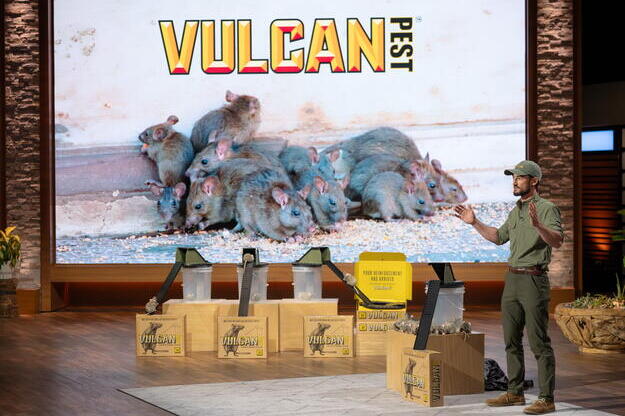
An education from the College of Agricultural, Consumer and Environmental Sciences at the University of Illinois Urbana-Champaign means critical thinking and hands-on learning across every major. That gives graduates an edge in the job market, but for Ian Fleming, it also meant becoming an inventor and scoring a deal on the hit TV show Shark Tank.
Fleming graduated in 2014 with a degree in Technical Systems Management (now Engineering Technology and Management for Agricultural Systems) from the Department of Agricultural and Biological Engineering in ACES. He appeared on the show in late October to pitch and ultimately receive financial backing for his company’s product, the Vulcan Pest Trap, a solution for rat infestations. In the following interview, he explains how his upbringing and experiences in ACES paved the way for his success.
ACES: You had an unusual childhood in South Africa; what led you from the African bush to Illinois and the College of ACES?
Fleming: I’m half Japanese, half Scottish, and I grew up traveling through Southern Africa with wildlife filmmaker parents. My father had been a crocodile hunter at one point of his life, and my childhood was spent on film shoots in the bush. At 18, I came to the U.S. on my own for the opportunities here. I applied to about 18 universities, and Illinois was the strongest in the fields I cared about. It was a huge shift, but Illinois became my home away from home, and it still holds a special place in my heart.
ACES: Why TSM (now ETMAS)? What appealed to you about that program vs. other majors?
Fleming: I came to Illinois to study engineering. Within my first year I realized I didn’t want to spend my career designing circuits on paper. I wanted to build things that worked in the real world, and to understand the business and the people around them. TSM was exactly that: engineering applied to real operations, inside one of the best agricultural engineering departments in the country. It was a better fit for how I think, and I’ve never looked back. I’ll never forget taking welding. There’s nothing like making something with your own hands that has to hold.
ACES: What specific lessons, ways of learning, or experiences did you pick up from TSM that led to your success?
Fleming: The habit of looking at a problem as a system before reaching for a tool. The Vulcan exists because I stopped asking, “what trap kills a rat,” and started asking, “how does a rat move, what does it trust, and where does it have to go every night?” That’s a systems question, and TSM taught me to ask it. The other thing was comfort with hardware. I’m not an engineer by title, but TSM made me unafraid to build, break, and rebuild a physical thing until it works.
ACES: Did you feel welcomed at ACES and Illinois as an international student?
Fleming: Absolutely. I joined the rugby team, and I still have lifelong friends from it and from ACES. ACES is a community that likes people who do things, and that was a good fit for someone arriving alone from the other side of the world.
ACES: Let’s move into the Vulcan Pest Trap. What was the original motivation to solve the rat problem? Who were you envisioning as the audience?
Fleming: I had rats in my own house in the Santa Cruz Mountains. I tried everything on the market. I came across bucket-lid traps and realized none of them actually work on rats; they are too smart and too suspicious. So I did what my father taught me growing up: observe the animal, then build the system. I built it for myself first. The audience turned out to be anyone with a rat problem a snap trap can’t solve: homeowners, farmers, people with chickens and barns.
ACES: Talk about what it was like to appear on Shark Tank. Any standout anecdotes? What will the deal mean for you?
Fleming: The hardest part isn’t the pitch. It’s standing behind the doors, waiting to walk out, with your heart in your mouth. Once you’re on stage, months of preparation take over. The biggest thing the show gave us was reach and credibility. Millions of people saw a bucket-lid rat trap and understood it in two minutes. We’re working with Daymond [John]’s team on what comes next.
ACES: What’s next for you and your company?
Fleming: Scaling the Vulcan is the near-term job: more channels, more retail, and more people with rats finding out there’s a better way. We’re also working on the next version of the trap and our first accessories. Rats aren’t going anywhere, so the plan is to be the company people think of when they see one.
ACES: Finally, what advice would you give current and future ETMAS students about making the most of their program?
Fleming: Don’t feel like you have to follow a set path. Most ACES graduates go into agriculture, and that’s a great career. I went somewhere else entirely, and the program prepared me for that too.
After graduation I moved to Silicon Valley without a job. I couch-surfed for three months before I landed one. I started in sales, moved into sales engineering, then became an applications engineer, then went back to sales managing some of the largest technology companies in the world, supplying them with critical AI infrastructure hardware. Along the way I got it in my head to build a consumer brand and started a coffee company with edible packaging. It failed, and I learned more from it than from almost anything else. Then I started Vulcan on nights and weekends while working full time.
None of that was a straight line, and none of it was planned. What carried me was what TSM taught me: how to solve real problems. Pair that with a growth mindset and there’s no path you can’t take. So get your hands on real problems while you’re there, take the internship, and learn to sell. Every technical person who builds something eventually has to explain why it matters to someone who doesn’t care how it works.
ACES: Anything else you’d like to add?
Fleming: I came to Illinois at 18 not knowing anyone. ACES took me in and taught me how to think about problems. I spent ten years in Silicon Valley in AI hardware, and right as the AI boom was taking off, I left to build a better rat trap. It’s not an obvious place for an ACES degree to lead, and that’s the point. If you want to go a certain direction, even an unusual one, you can.