How long does it take to grow a tree that supports endangered Indiana bats?
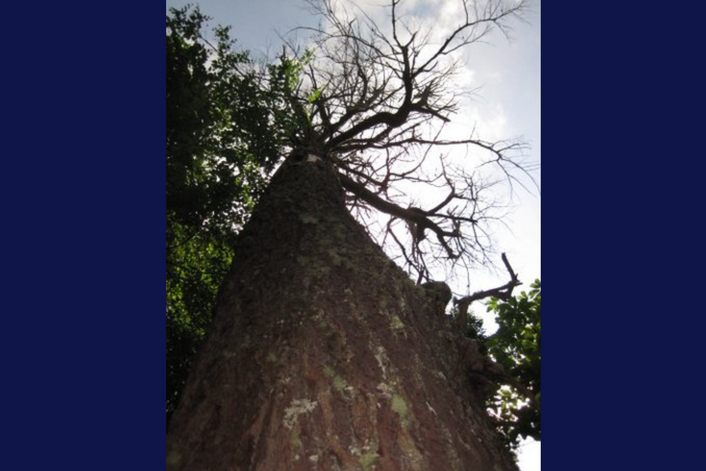
Bugs run rampant in the summer, and if you have ever suffered from a mosquito bite and regretted not putting on bug spray, you should know about nature’s insect repellent: the Indiana bat. Federally endangered since 1967, the Indiana bat (Myotis sodalis) helps with pest control and supports tree growth in forests, but their habitat has been shrinking.
In a recent study, researchers from Minot State University and the University of Illinois Urbana-Champaign identified factors that make trees suitable roosts, informing forest managers about strategies to help preserve the Indiana bats.
Tree size, measured by diameter, is the most important determinant for making a good shelter for Indiana bats, said lead author Joseph Pettit, associate professor at Minot State University. The age of a tree is less significant — a good thing for the bats. As long as a tree is the proper size, it does not matter how long it took to grow, meaning forest managers can accelerate the process.
“Diameter predicts which trees house the most bats,” Pettit said. “We’ve known that for a long time. Our question was specifically, ‘How can we quickly get to that diameter?’ And the answer is early-successional trees.”
Succession is the predictable process by which plant species grow and forests develop. Early in the process, faster-growing, “weedy” plants lay the necessary foundation for slower-growing species, including soil buildup, solid enrichment, and shade.
“On average, you need about 100 years if you’re going to make an Indiana bat roost tree,” Pettit said. “But there’s a little bit more nuance to it: the characteristics of the tree matter, too. Some trees — early-successional trees — can grow very quickly. They can be viable for bats in about 70 years, whereas late-successional trees typically take 130 years.”
Early-successional trees tend to be intolerant of shade, grow rapidly in the abundant light, and have short lifespans. In contrast, late-successional trees tolerate shade and typically grow in a closed-canopy forest. They mature more slowly and live longer than early-successional trees.
Both types of trees are needed in forest management practices to provide viable roosts for the Indiana bat.
“A smart management approach recognizes the importance of maintaining a combination of early-successional and late-successional trees,” said co-author Joy O’Keefe, associate professor and wildlife Extension specialist in the Department of Natural Resources and Environmental Sciences and Illinois Extension, both part of the College of Agricultural, Consumer and Environmental Sciences at Illinois. “Each provides a unique benefit that is necessary to create consistent habitats for the bats.”
To determine which trees Indiana bats preferred, the team radiotagged the bats and tracked them to their roosts. They surveyed 95 roost trees across three study sites: central Indiana, the Great Swamp National Wildlife Refuge in New Jersey, and the Southern Appalachian Mountains. According to Pettit and O’Keefe, the sites were a representative sample of the eastern U.S. forests, which the study focused on. The team used dendrochronology — analysis of the trees’ rings — to establish the ages.
“The oldest late-successional tree that we surveyed was around 250 years old,” Pettit said. “That’s a very long time to wait if a bat needs a roost immediately, so the take-home message for managers is if you need forest to shelter bats quickly, early-successional trees can accomplish that more quickly.”
Typically, the Indiana bats roost in standing dead trees, known as snags, because the bark starts to split about four years after the trees die. The separation leaves an ideal space for the bats to shelter in.
Late-successional trees remained upright for an average of 12 years, according to the research, whereas the early-successional trees fell over about eight years after their death. Because the late-successional trees stand for longer after they die, they house the bats for a longer period of time.
Both early and late-successional trees have strengths for providing shelter to the Indiana bats, and their characteristics should be taken into account in forest management practice. According to the group’s findings, managers must create a new, suitable roost for the bats every 3 or 4 years to maintain a constant amount of habitat, and there must be enough viable trees to accomplish that.
“If our goal is to be able to design and create good habitats for this endangered species, it is amazing that age is not the main predictor of how many bats roost in a tree,” Pettit said. “It means that we can grow big trees that do not need to be immensely old.”
He and O’Keefe explained that, regardless of the type of tree, creating good habitats for bats will take time. Even if early-successional trees can be viable in 70 years, that time frame is longer than most forest managers’ tenures.
“We’re going to need to be thoughtful about creating the natural habitat that these bats need, and we will have to plan very far in advance — beyond our own lifespan, in many cases — to create the conditions to help preserve these bats,” O’Keefe said. “There is no better time to start than now.”
There are four other endangered bat species east of the Mississippi. The study’s findings about roost age do not necessarily apply to all of them, as some shelter in places other than trees, but the pair said the study’s framework is a baseline that future researchers can follow.
“We can take what we learned from this study and analyze how to best create a habitat for each type of bat,” O’Keefe said. “By applying the same framework, we can determine what the necessary characteristics of habitats are for all types of endangered animals — bats or otherwise.”
The article, “Tree roosts used by an endangered bat require almost a century to develop,” is published in Forest Ecology and Management [DOI: 10.1016/j.foreco.2026.123942].