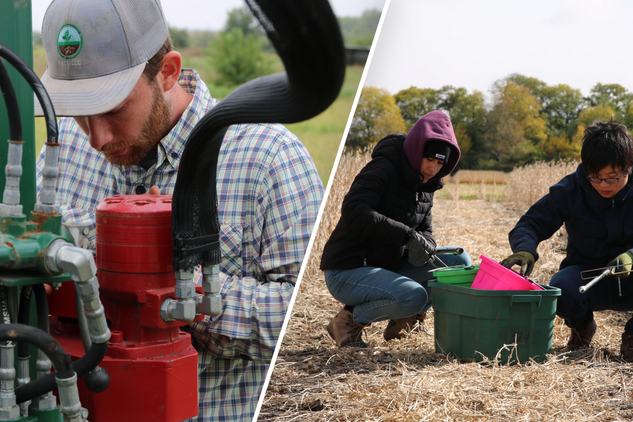
Two University of Illinois Urbana-Champaign researchers have received nearly $1.6 million from the Foundation for Food & Agriculture Research’s Efficient Fertilizer Consortium to study how fertilizers perform under Midwestern growing conditions.
Andrew Margenot and John Jones, both faculty members in the Department of Crop Sciences and members of the Illinois Nutrient Stewardship Alliance, will lead complementary projects examining nitrogen and phosphorus management. Their work will measure crop response alongside nutrient runoff and leaching, generating practical information farmers can use to improve fertilizer efficiency and profitability.
The awards are part of a $9.3 million FFAR investment across 12 projects evaluating enhanced-efficiency fertilizers and related management practices in varied soils, cropping systems, and climates.
“Growers need robust, science-backed guidance for practical solutions that improve nutrient use efficiency in real-world conditions that reflect their own farming practices,” said Sarah Lyons, FFAR scientific program manager. “These investments support actionable research that can help farmers make better and more profitable management decisions to strengthen productivity and environmental stewardship.”
Margenot, who also serves as the associate director for the Agroecosystem Sustainability Center (ASC), received $768,000 to measure how enhanced nitrogen use efficiency fertilizer products and practices perform in tile-drained corn systems. The project will feature replicated evaluations of monitored subsurface tile drainage, enabling the team to evaluate fertilizer use efficiency and nitrogen losses through both gaseous emissions and leaching.
“This project will help test a new protocol for evaluating enhanced-efficiency fertilizer products under real Midwestern growing conditions,” Margenot said. “At the same time, it will generate locally relevant information about the agronomic and economic performance of nitrogen management practices that Illinois farmers can use when making fertilizer decisions.”
“Many of the nitrogen-loss reduction practices promoted in Illinois are designed to reduce nitrate moving through subsurface tile drainage,” he added. “However, we still lack enough high-confidence field measurements showing exactly how much nitrate leaves fields through those systems. By pairing detailed water-quality measurements with crop yield and economic data, we can directly evaluate whether these practices work as intended. That gives farmers and policymakers stronger information on which practices deliver both environmental and agronomic benefits.”
Jones received $843,000 to conduct field-scale evaluations of phosphorus fertilizers and their ability to prevent nutrient runoff and leaching across diverse Midwest soils and environments. His lab will compare fertilizer products, application timing, placement, and rates while measuring both agronomic performance and environmental outcomes.
The four-year project will use rainfall simulations to capture surface runoff and specialized equipment to estimate nutrient movement through the soil. Its multi-year design is especially important for phosphorus, which is less mobile in soil than nitrogen and cannot always be evaluated accurately from a single growing season.
“Phosphorus does not move or behave like nitrogen, so a one-year snapshot can miss much of the story,” Jones said. “By evaluating these products and management practices over multiple seasons, we can give farmers a clearer picture of how efficiently phosphorus is being used and where losses may occur.”
Margenot is also a co-principal investigator on Jones’s project, creating opportunities for the teams to coordinate field research and outreach on the two most important nutrients for crop production and water quality in Illinois and the broader region. Research sites for the two projects are located near one another on the Urbana campus, allowing the teams to demonstrate nitrogen and phosphorus studies together at future field days.
All projects funded by the Efficient Fertilizer Consortium are required to follow its Field Trial Guidelines for Evaluating Enhanced Efficiency Fertilizers. Developed with experts from academia, government, industry, and commodity groups, the guidelines support scientific rigor and consistency across locations and projects.
Connecting research with Illinois farms
The FFAR awards come as the College of Agricultural, Consumer and Environmental Sciences and Illinois Extension deepen their partnership through the nearly $2 million Illinois ACES Land Grant Initiative.
Margenot is leading one of four projects selected through the new initiative. The three-year project, “Bridging the gap by bringing the land grant to the field,” will establish a coordinated workflow for farmer-centered nutrient management research and outreach.
The project brings together Illinois researchers, Extension professionals, farmers and agricultural stakeholders to identify nutrient management needs, co-design studies, conduct on-farm trials, synthesize findings, and communicate results. Jones is a co-investigator on the project, along with fellow Illinois Nutrient Stewardship Alliance (INSA) members and Extension educators from across Illinois.
INSA is supported by the Illinois Farm Bureau and Illinois Corn Growers Association. It was established to better integrate nutrient management research, expand on-farm studies and make findings more accessible and useful to farmers throughout the state.
Together, the FFAR and land-grant initiative investments support different parts of that mission. The FFAR grants fund rigorous nitrogen and phosphorus research, while the land-grant initiative strengthens the relationships and infrastructure needed to shape projects around farmers’ needs and move results into practice.
The coordinated approach also highlights the breadth of University of Illinois agricultural research occurring across the state. INSA researchers currently conduct on-farm studies throughout Illinois, from the northern part of the state to its southernmost farming regions.
“These projects give us a chance to connect careful field research with the questions farmers are asking across Illinois,” Jones concluded. “The goal is not simply to generate more data. It is to produce information that farmers can use under the soil, weather and management conditions they actually face.”