What is red crown rot? Illinois expert explains emerging soybean pathogen
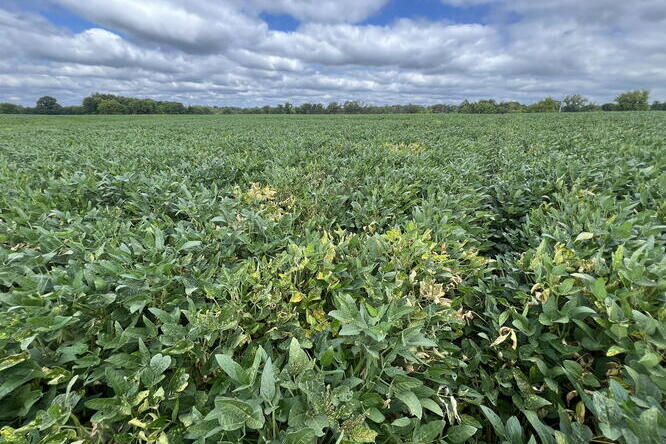
Red crown rot, a fungal disease of soybean, is not new to the Midwest. First reported in Illinois in 2018, the disease is now surging across the state and the region. Boris Camiletti, a plant pathologist at the University of Illinois Urbana-Champaign, is leading the effort to understand and combat the scourge, along with the Crop Protection Network, the Illinois Soybean Association, the United Soybean Board, and researchers in surrounding states.
What is red crown rot?
Red crown rot is caused by a fungus called Calonectria ilicicola (previously known as Cylindrocladium parasiticum). The fungus lives in soil, attacking roots.
“We know that it spreads with the soil, so any kind of soil movement or machinery that may have some soil attached, it's spreading that way,” said Camiletti, an assistant professor and Illinois Extension specialist in the Department of Crop Sciences, part of the College of Agricultural, Consumer and Environmental Sciences at U. of I.
Infection starts when tiny, hardened structures in the soil called microsclerotia germinate to sprout the vegetative body of the fungus, or hyphae. The threadlike hyphae then penetrate root cells and travel into the plant, producing toxins that eventually kill plant tissue.
Microsclerotia are extremely hardy and can persist in the soil for several years, Camiletti says. Nearby roots can stimulate them to germinate, and warm, wet conditions favor infection of young soybean roots.
Red crown rot symptoms
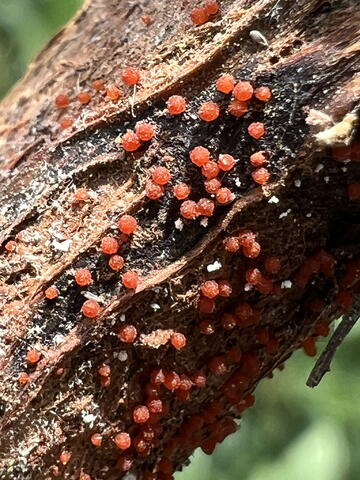
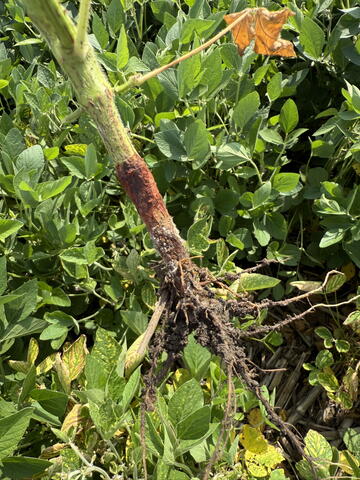
Red crown rot often becomes visible initially at the root crown, the location just under the soil where the roots meet the stem. The crown and lower stem can take on a reddish tinge, accompanied by fungal structures, such as white patches or tiny brick-red spore-producing spheres known as perithecia.
The disease may attack early in the life of the plant and persist or worsen throughout the season. A reddish stem may be visible during the vegetative stages (as early as V2) in soybean, but it’s often not until the reproductive phases, typically between R3 and R5, that foliar symptoms can be observed. Chlorosis, or yellowing, begins between veins, leading to necrosis, or leaf death. Severe infestations can decrease yield by 60-70%.
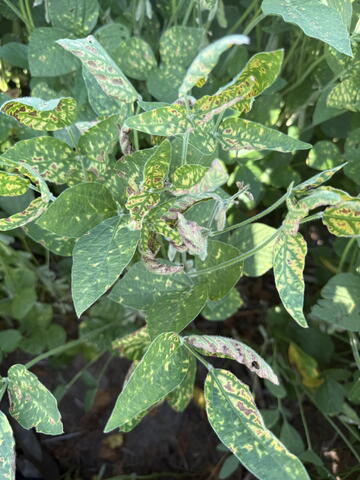
“This disease can produce foliar symptoms that are almost identical to more traditional diseases like sudden death syndrome and brown stem rot, or even damage from some fungicides like triazoles,” Camiletti said. “We think that was probably one of the factors that kept us from detecting this disease early. Based on foliar symptoms only, you might think that you are dealing with something else, but it's actually red crown rot.”
Camiletti says because the foliar symptoms closely resemble other diseases and characteristic structures like perithecia may not be visible until late in the season, it is important to test all suspicious plants.
To find out if your plant is infected, submit a sample to the Illinois Extension Plant Clinic.
Mapping red crown rot in the Midwest and across the farm
Since its initial confirmation in Illinois’ Pike County in 2018, red crown rot has spread to 51 counties across the state and has been detected in Indiana, Iowa, Kentucky, Missouri, Nebraska, Ohio, and Wisconsin.
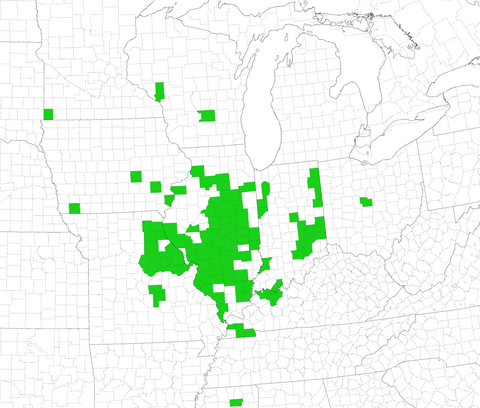
“We know the disease is spreading across the Midwest, but it is probably much more widespread than the maps show. We have some blank areas that we cannot explain. It is probably because we are missing observations from those counties,” Camiletti said. “We need to improve our scouting efforts and screenings to find the disease because it's probably out there.”
Within farms, disease incidence can vary markedly between fields.
“If you compare a diseased patch with a healthy area, you may see a 60-70% yield reduction. In the end, the total yield reduction depends on how big those patches are,” Camiletti said.
Products and practices to suppress red crown rot
While Camiletti says there’s no surefire way to control red crown rot in soybean, there are products and practices that may help.
In addition to scouting for and testing symptomatic plants, it’s imperative to avoid moving infected soil within and between fields, and to plant known infected fields last. It’s also a good idea to sanitize equipment between fields, Camiletti says.
Unlike these cultural management practices, crop rotation is less likely to make a difference.
“I've seen a lot of farmers doing continuous corn for two, three years, trying to outlast the disease,” Camiletti said. “Unfortunately, there’s no strong evidence to support crop rotation as a way to combat red crown rot. That's because the inoculum can remain in the soil for several years. And continuous corn may trigger other problems in corn, as well.”
A handful of seed treatments are labeled to suppress the disease in the first few weeks after planting. Camiletti points growers to the Crop Protection Network’s 2026 guide to fungicide efficacy for details relevant to the North-Central region.
“We are seeing a lot of variability in resistance with different soybean varieties. So, the other recommendation we always make to farmers is to ask their seed dealer if they have ratings for this disease or if they have information about varieties they should avoid,” Camiletti said. “In our research, we are also seeing interactions between seed treatments and different soybean varieties.”
Further research
Camiletti and his partners are testing soybean varieties and seed treatments to best advise growers. They’re also starting a project to help farmers make informed economic decisions about treatments to combat red crown rot and other fungal soybean diseases.
Due to the patchy nature of these diseases, farmers often lack information on how much of a field is affected and whether higher-cost seed treatments and inputs are economically justified. The new project, part of the Illinois ACES Land-Grant Initiative, will combine satellite imagery, field data, and machine learning to create a decision-support system that helps producers target disease management investments more effectively.
Through the Crop Protection Network, the team will deliver two practical tools: a Disease-Area Estimator that maps affected portions of fields and an ROI Calculator that evaluates treatment decisions based on disease extent, risk, input costs, crop prices, and expected returns.
“By bringing together a team of Extension professionals, industry partners, and producers, we hope to deliver more precise, economically sound soybean disease management recommendations across the region,” Camiletti said.
The Land-Grant Initiative is a newly piloted competitive grant program funding projects co-led by ACES researchers and Extension staff. Like other internal funding opportunities offered by the ACES Office of Research, IALGI supports innovative, interdisciplinary, and solutions-oriented research with federal funds. But IALGI uniquely draws on the expertise and connections of Extension personnel, who are helping guide study design and implementing results directly in communities across the state.