John Reid receives prestigious engineering award
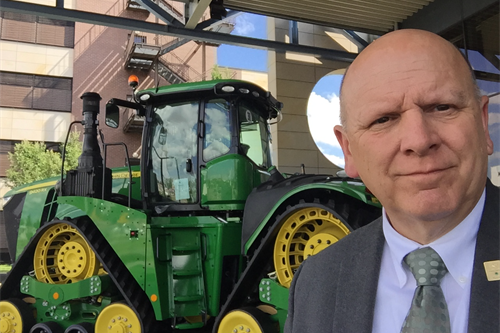
University of Illinois Urbana-Champaign research professor John Reid, also executive director of the Center for Digital Agriculture, received the prestigious 2026 Cyrus Hall McCormick-Jerome Increase Case Gold Medal.
The award, presented by the American Society of Agricultural and Biological Engineers (ASABE), honors exceptional meritorious engineering achievement in agriculture that has resulted in new concepts, products, processes, or methods that advanced the development of agriculture.
“What makes this recognition especially meaningful is that it reflects the contributions of many students, colleagues, and industry partners who shared in this journey,” Reid said.
Reid is a professor in the College of Agricultural, Consumer and Environmental Sciences and The Grainger College of Engineering at Illinois.
“Reid is a brilliant example of the incredible people we have on campus,” said Ronaldo Maghirang, head of the Department of Agricultural and Biological Engineering, part of ACES and Grainger. “He — and so many others here — are merging their expertise and industry knowledge to be the leaders of their research fields. This award is proof of our faculty’s excellence.”
Just a short distance from where Cyrus Hall McCormick, the award’s first namesake, developed and successfully demonstrated the first mechanical reaper in 1831 in Raphine, Virginia, Reid began his journey helping out on his grandparents’ farm.
“I enjoyed the hard work and the sense of accomplishment that came with farm work, but the engineer in me was always asking why certain jobs had to be so difficult and whether there might be a better way to do them,” Reid said.
Those early experiences planted the seeds for his later interest in automation, productivity, and using technology to help farmers. Reid earned his bachelor’s and master's degrees in agricultural engineering from Virginia Tech, and then he proceeded to Texas A&M for his doctorate in the same field.
In 1986, Reid came to the U. of I., inspired by its location at the heart of the nation’s production agriculture industry — and with it, the engineering problems he wanted to address. Here, he connected with the legacy of the award’s second namesake: Jerome Increase Case.
“With the company Case IH, our team in Agricultural and Biological Engineering in the mid-1990’s developed and field-tested some of the earliest autonomous tractors for production agriculture at the University of Illinois South Farms,” Reid said.
In 2001, Reid joined John Deere and supported commercialization of many of the technologies that enabled the industry’s transition from automation to autonomy.
About two decades later, equipped with industry experience, Reid returned to the U. of I., where he now applies his expertise to new challenges in autonomy, robotics, and AI.
A major focus of his research is how automation and autonomy can benefit small- and medium-sized agricultural enterprises.
One example is Reid’s work with horseradish growers in Illinois and Wisconsin. Horseradish production still relies on traditional mechanization and labor-intensive practices. Because the industry is relatively small, it is difficult to justify dedicated commercial equipment. Reid and his colleagues are developing affordable robotic and AI-enabled technologies that can improve productivity for specialty crop producers who are often overlooked by traditional equipment manufacturers.
Reid also serves as the University of Illinois campus lead for the National Science Foundation Center for Research on Programmable Plant Systems, helping connect researchers across engineering, computing, and plant sciences. The center is exploring a future in which crops, sensors, robotics, and artificial intelligence work together as intelligent agricultural systems capable of responding more precisely to changing environmental conditions.
“What excites me is that we’re moving beyond making machines smarter,” Reid said. “We’re beginning to think about intelligent agricultural systems where plants, sensors, robots, and AI work together to improve productivity and sustainability.”