Veteran shares how his ACES education fueled his career
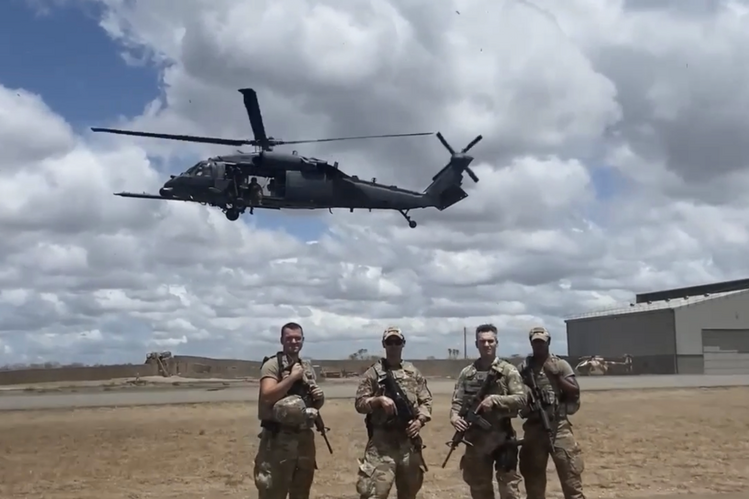
The military might not be the first career you think of when you hear about pathways after graduating from the College of Agricultural, Consumer and Environmental Sciences at the University of Illinois Urbana-Champaign.
But for ACES alum Leonid Vityuk, who graduated with an Engineering Technology and Management for Agricultural Systems degree in 2019, joining made perfect sense. He spent 12 years in the Air Force — and he said his ACES education is what helped him excel.
ETMAS is in the Department of Agricultural and Biological Engineering, part of the College of ACES and The Grainger College of Engineering at Illinois.
After graduating from high school, Vityuk joined the Air Force. He attended Illinois with the help of the GI Bill before becoming a member of the 264th Combat Communications Squadron in Peoria, Ill.
In his time with the squadron, Vityuk helped organize communications infrastructure in remote or contested environments. Whether setting up internet services or radio and satellite systems, Vityuk said his engineering background helped him feel prepared.
“It was very complementary,” Vityuk said. “The classes at Illinois opened doors and allowed me to do much better in the military.”
Vityuk remembered his electrohydraulics and microelectronics courses, in which he worked with software and microcontrollers in a real lab. He also recalled welding and wiring complex systems — all of which taught him skills that directly applied to his work with communications systems.
While deployed in Kenya, Vityuk was one of a handful of communications people at the base. He organized the radio networks for the various groups — the medical teams, fire department, and military police, among others — limited radio clutter, and prevented frequency collisions.
Vityuk compared organizing the moving parts to conducting an orchestra.
“That practical engineering knowledge came in handy, for sure,” Vityuk said. “There were a lot of technical considerations aside from the software. It takes lots of planning and organization.”
Vityuk’s time in ACES taught him how to think critically and search for answers when he ran into problems. He said those skills and outside-of-the-box thinking helped him.
“It’s been absolutely tremendous for my career,” Vityuk said.
While in the military, Vityuk said he further developed his leadership skills and improved his ability to think from multiple perspectives. Paired with his technical knowledge from ACES, Vityuk has pivoted to a new path.
Vityuk is now the Delivery Director for the L&T Technology Services Peoria Design Center. In his current role, Vityuk often collaborates with Caterpillar and John Deere to improve the software for the controllers embedded in heavy machinery. He also oversees a team of engineers.
Vityuk’s path may not be the one you first imagine when you think of an ACES education, but he said it prepared him nonetheless. He also encouraged people to take leaps into new fields, even if they do not perfectly align with their studies.
“Fall back on your education,” Vityuk said. “Even if an opportunity seems like a shot in the dark, ACES gives you the background, the skills necessary to succeed.”