New model reveals how water moves through tile-drained farm fields
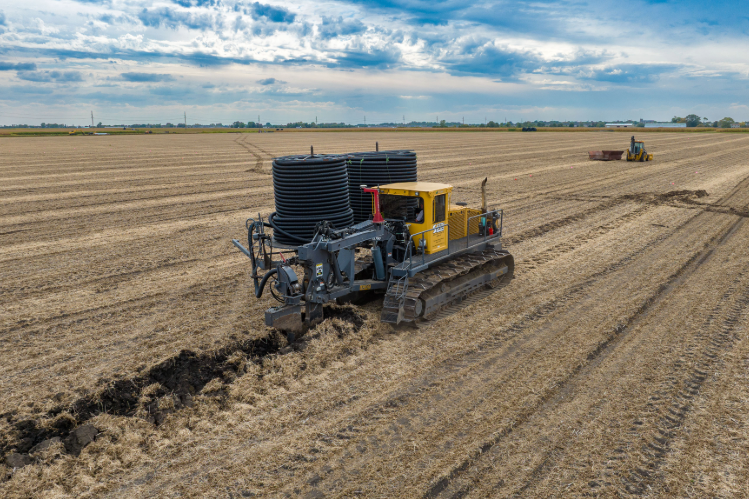
Tile drainage fundamentally alters how water moves through agricultural fields, affecting surface ponding, water-table dynamics, crop growth, nutrient transport, and water quality. Yet fields with similar drainage systems can respond differently depending on soil, topography, and tile design — differences that most models struggle to resolve at the field scale.
A new University of Illinois Urbana-Champaign study, published in the Journal of Hydrology, addresses that gap with high-resolution, three-dimensional modeling of surface and subsurface water movement. Working with collaborators at Oak Ridge National Laboratory, the Illinois team used two tile-drained fields at the University of Illinois Energy Farm to incorporate mapped tile locations and evaluate how model resolution, microtopography, soil properties, and tile depth and spacing affected drainage.
“Our model provides a three-dimensional picture of how water moves across the field surface and through the soil after heavy rainfall,” said lead author Bin Peng, assistant professor and faculty Extension specialist on agricultural hydrology and water quality in the Department of Crop Sciences, part of the College of Agricultural, Consumer and Environmental Sciences at Illinois. “For example, we can simulate where surface ponding occurs, how large the ponded areas are, how long the water remains on the surface, and how quickly the water table drops after a rainfall event.”
The researchers tested two approaches for representing tile drainage at the field scale in the Advanced Terrestrial Simulator, an integrated surface-subsurface hydrological model developed through collaboration among several U.S. Department of Energy national laboratories. Both reproduced field-scale drainage reasonably well but offered different advantages depending on the research question.
One of the study’s more surprising findings was that simulations ranging from 2- to 40-meter resolution produced similar estimates of overall field-scale drainage after appropriate parameter adjustments.
“Even at 40-meter resolution, the model could reproduce the overall tile-drainage hydrological response reasonably well,” said first author Haoyuan Yu, a doctoral student supervised by Peng. “However, when we looked at the spatial patterns, the differences became much clearer. The 2-meter model preserved local surface depressions, ponding patterns, and near-drain flow structures, while the 40-meter model smoothed out many of these features.”
The results suggest researchers may not need the highest resolution to estimate overall field drainage or water-table response. Finer resolution becomes more important for determining where water ponds, how it moves through soil, and where it reaches the tile network.
“These differences matter because water pathways influence where water accumulates, how long it stays in the soil, and how it interacts with the surrounding environment,” Yu said. “This becomes more important when we want to study nutrient transport and biogeochemical reactions in the future.”
The simulations also showed how field characteristics and drainage design alter those pathways. Small variations in surface topography affected where water ponded and entered the soil, while soil properties influenced the balance among runoff, evapotranspiration, and tile drainage.
“Drain depth had a stronger influence on long-term cumulative drainage and water-table levels. Deeper drains generally lowered the water table and increased cumulative drainage,” Yu said. “Tile spacing, on the other hand, had a stronger influence on how quickly the drainage system responds to rainfall events. More closely spaced drains generally produced stronger peak drainage responses.”
The model allows researchers to test different tile locations, depths, and spacing to examine how drainage design could affect ponding and water-table conditions before changes are made in the field.
The current study focuses on water, but the same pathways ultimately determine where dissolved nutrients can travel.
“Nitrate is highly soluble in water, so its movement is strongly connected to how water moves through the soil and drainage system,” Peng said. “By better understanding the hydrological pathways, we can build a stronger foundation for predicting where nitrate might move and how it reaches the drainage network.”
Peng’s team is building on the hydrological framework by incorporating carbon and nitrogen cycling and reactive transport processes.
“We are using the model to reconstruct the water and nitrogen budgets of different bioenergy crops and compare those with traditional corn-soybean rotation systems,” Peng said. “Our ultimate goal is to have a field-to-watershed digital twin for integrated surface-subsurface processes to guide landscape design for the bioeconomy, sustainable land management, and precision conservation across extensive agricultural landscapes.”
Research in the College of ACES is made possible in part by Hatch funding from USDA’s National Institute of Food and Agriculture. This study was also supported by the U.S. Department of Energy Center for Advanced Bioenergy and Bioproducts Innovation, the Illinois Nutrient Research and Education Council, USDA National Institute of Food and Agriculture, and the Dudley Smith Initiative.
The study, “Characterizing field-scale hydrology over tile-drained farmland with high-resolution integrated surface-subsurface hydrological modeling,” is published in the Journal of Hydrology. DOI: 10.1016/j.jhydrol.2026.136751
Media contacts
Austin Keating
Communication & Outreach Lead
akkeati2@illinois.edu
217-259-5829
Bin Peng
Assistant Professor
Department of Crop Sciences
binpeng@illinois.edu
217-974-5389