Bin Peng receives conservation research award, improves farmer success
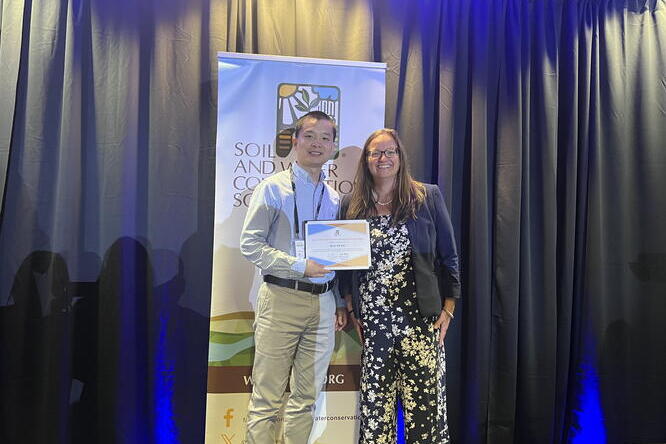
Bin Peng, assistant professor at the University of Illinois Urbana-Champaign, recently received a Conservation Research Award from the Soil and Water Conservation Society, recognizing his excellence in soil, water, and nutrient conservation research.
Peng is in the Department of Crop Sciences and is an Illinois Extension Specialist, both part of the College of Agricultural, Consumer and Environmental Sciences.
“I feel honored and very excited,” Peng said. “This is such a wonderful opportunity to further promote my research and Extension work.”
The award recognizes Soil and Water Conservation Society members whose research has led to “exceptional improvements” in the field. Beyond lab and field work, Peng uses analytical tools like geospatial data, computational modeling, AI, and machine learning to improve precision conservation — using the right management practices in the right locations.
With his research on farms across Illinois and the entire nation, Peng helps various stakeholders, such as individual farmers, watershed managers, and policymakers, to make decisions about their conservation efforts.
Most management practices occur at the field level. Farmers take care of their own fertilizer and conservation management. However, environmental outcomes are normally measured at a larger scale. For example, water quality is often measured at a watershed level — which can stretch thousands of miles.
“So, there’s a scale mismatch,” Peng said. “We need to find a way to bridge that gap, and I believe big data and computational tools are what we need to accomplish that.”
By looking at the landscape over the last 30 years, Peng can determine what was planted and how much is harvested — even what conservation strategies were implemented on the ground. From there, he and his team can interpret the historical data and develop predictive models from field to watershed scales.
“Basically, we are building a digital brain for landscape management,” Peng said.
Ten years ago, Illinois developed a nutrient-loss reduction strategy. Now, equipped with more data and these new analytical tools, Peng says that strategy can be refined. Peng is a member and the chair for 2025-2026 of the Illinois NLRS Agricultural Water Quality Science Team. Filling research gaps for developing such an improved strategy is one of his goals in the upcoming years.
Peng’s work also benefits individual farmers. Using his analytical tools and models, Peng can look at a specific farm’s strategy and determine the outcomes.
“There are so many knobs you can tune in a farmer’s system,” Peng said. “If you change one, what would be the yield? The nutrient outcome? The water quality? The soil health outcome? My goal is to use a systems approach and leverage the state-of-the-art tools such as computational models and AI to tailor site-specific conservation recommendations”
With a full picture of the possible outcomes, farmers can be more informed to adjust certain knobs and fine-tune their strategies to achieve their desired results.
“I’m so grateful my research is being recognized, but that isn’t the main takeaway,” Peng said. “People at our university, including my fellow group members, are working every day to help improve farmers’ successes, conserve natural resources, and protect our living environment.”