Celebrating 25 years of ACES-led sustainable ag innovation in Christian County and beyond
Since 2001, the Dudley Smith Initiative has been quietly advancing the land-grant mission at the heart of the College of Agricultural, Consumer and Environmental Sciences at the University of Illinois Urbana-Champaign, providing a testbed for efforts that strengthen the Illinois agricultural system and the communities that support it.
The DSI is both a 228-acre farm in Christian County and a funding stream for interdisciplinary, solutions-oriented research. It started with a gift of farmland to the university, followed by a substantial endowment by Dudley Smith Jr., who began managing his family farm in 1920. Through a longtime correspondence with leaders of the College of ACES, Smith Jr. revealed a concern for the future of farming and a desire to contribute to research that would sustain farmland and the rural community.
Dudley Smith Jr.’s endowment came in 1993, but it took some time to work out the vision and structure of the DSI. The initiative’s first research project was funded in 2001, and ACES scientists and Illinois Extension specialists have been working ever since to improve agricultural practices and the rural economy in Christian County and beyond.
How sustainability-focused research at the Dudley Smith Initiative has impacted Illinois
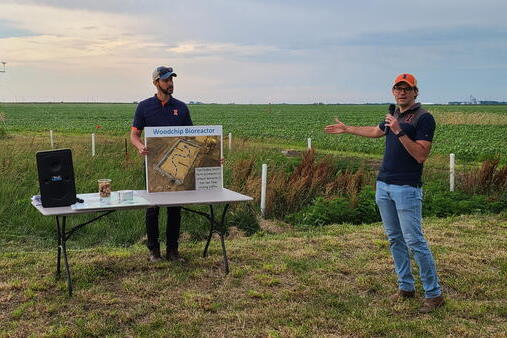
DSI-supported projects have sustainability at their core. Over the past quarter century, researchers have gained important new insights into livestock-crop integration, rotational grazing, and cover crop grazing. Others have refined the agronomy, harvest, and processing of perennial biomass crops into valuable energy products, including combustible pellets that heat the Christian County Extension Office. Still other researchers have focused on water quality, including tile drainage monitoring and testing some of the state’s first full-scale woodchip bioreactors as a means to reduce nutrient loss to waterways.
“Historically, the research that has been done at the Dudley Smith Farm has pushed the envelope for its time. Some of our earliest work on biomass and cover crops, livestock-crop integration, and nutrient loss prevention — not to mention community and economic development — has been done through DSI,” said ACES Associate Dean for Research, Rod Johnson.
How does funding from the Dudley Smith Initiative work?
The DSI offers two types of funding: DSynergy grants, which fund one- or two-year projects seeking to define research and outreach integration across disciplinary boundaries; and DSystems grants, funding larger-scale projects up to four years.
“It's a unique model. There are a lot of parties involved to make sure we are conducting research at a level that's actually going to meet the Extension vision of practical application on the farm. Once proposals are funded, we meet with researchers regularly to ensure their findings make it back to the farm and that they’re meeting the goals of profitability and sustainability for the farmer,” said Micah Pope, senior consultant at Centrec Consulting Group, which handles the endowment in conjunction with the ACES Office of Research. “The fact that it has lasted 25 years is something to celebrate.”
Current DSynergy projects are exploring the capture and reuse of drainage water for irrigation; the potential of alternative cover crops; and the optimization of integrated cover crop-grazing systems. A multi-year DSystems project is working to understand and scale nitrogen budgets at the field and watershed levels across the state’s tile-drained acres.
How farmers get involved in Dudley Smith Initiative research
The DSI hosts field days twice a year, in summer and winter. They’re an opportunity for area producers to learn directly from the research teams. But that’s not the only way producers get involved.
“The DSI has been an impactful part of serving the land-grant mission,” said Travis Meteer, an Illinois Extension educator focusing on beef operations. “Bringing University of Illinois research and researchers to the fields of rural Christian County has not only created an opportunity to connect with local communities, it has provided a host site for ideas and experiences to be exchanged between farmers, researchers, and Extension professionals. Strong local partners have farmed the lands and assisted in carrying out many research projects. Leadership and oversight from local farmers and board members has kept the focus on research that can contribute to sustainable and practical solutions for farmers.”
Matthew Vann, associate dean and director of Illinois Extension, agrees. That circularity of feedback, from practitioner to researcher and back, is exactly how it should work.
“That’s how we solve real problems,” Vann said. “We see this at DSI and in every county Extension office across the state. Our staff is out there listening to what folks are struggling with, and feeding it back to researchers on campus or on our research farms, who try to solve those problems. We’re doubling down on this system going forward.”
The future of the Dudley Smith Initiative
With 25 years of research innovation under its belt, the DSI has developed practical and sustainable solutions for Christian County farmers and beyond — and it’s not going anywhere. While it’s impossible to say what challenges farmers will face over the next 25 years, ACES researchers will stand at their side — at the DSI and around the state — to help find solutions.
To learn more about supporting research and Extension in the College of ACES, contact the ACES Office of Advancement at acesadvancement@illinois.edu or 217-333-9355. Gifts can be made online at aces.illinois.edu/give.