Video premiere event brings untold community histories “out of the basement”
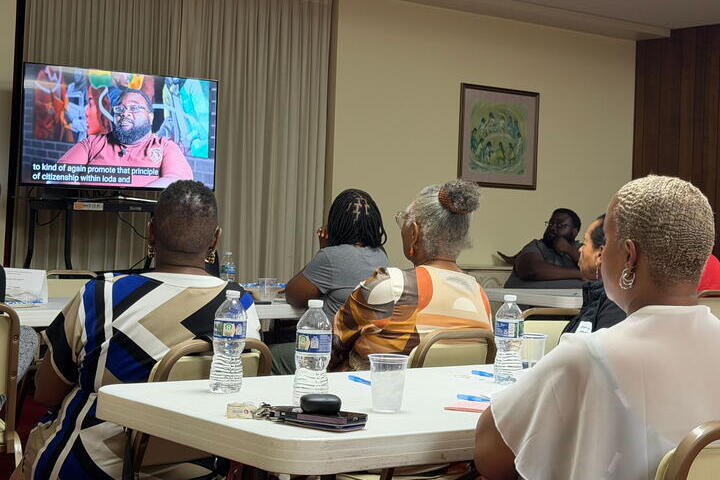
On the evening of Tuesday, June 30, the Family Resiliency Center at the University of Illinois Urbana-Champaign and collaborators from local chapters or sections of “Divine Nine” organizations—the nickname for the coalition of nine historically Black sororities and fraternities—as well as affiliated organizations like the National Council of Negro Women and the National Association for the Advancement of Colored People hosted a video premiere event titled “Out of the Basement.” Attendees filled the second floor of the First United Methodist Church of Urbana to watch short videos, produced over the past few months, about the histories and current activities of these organizations.
- The Olympics of the Mind - ACT-SO Champaign County https://youtu.be/bvy7eqXZNnw
- "I" is for "Individual" - Iota Phi Theta, Kappa Omega Chapter https://youtu.be/sLygM2vtIxA
- A Better Place for All of Us - NAACP, Champaign County Branch https://youtu.be/bwBLAGVzvn4
- Work Continues - NCNW, Champaign County Section https://youtu.be/SwbMXTyUX1U
- A Lasting Legacy - Zeta Phi Beta, Theta Lambda Zeta Chapter https://youtu.be/W2YH6ezyKx0
- “What comes to mind when you think about healing?” https://youtu.be/SI5h-6oOS4U
“Out of the Basement” afforded the opportunity not only to discuss the videos but to reflect broadly on the meaning of and possibility for racial healing. The event and new video production were funded by a grant from Healing Illinois, an initiative of the Illinois Department of Human Services that seeks to foster racial and community healing.
“We have an opportunity with these resources to give underrepresented communities—Black communities—to get their history and their name out, so that they’re no longer a ‘best-kept secret,’” said Shandra Summerville, president of Zeta Phi Beta Sorority, Theta Lambda Zeta Chapter and consultant on the project. “Healing Illinois is an opportunity to bring history out of the basement and out of the graveyard into the world.”
The project was funded as part of Healing Illinois’ “healing through narrative” track, which features stories about communities that have been overlooked, misunderstood or silenced due to their racial identity. Throughout the process of recording, editing and producing the videos, FRC Associate Director Nathaniel Underland asked questions not only about the organizations’ histories and contemporary activities but also about each participant’s thoughts on healing and the possibility for narrative or storytelling to heal.
“The diversity of responses was moving,” Underland said, “yet each participant professed a belief in the power of storytelling and a desire to shape their own narrative.”
Some interviewees, like Michael Smith, community service chair of Iota Phi Theta Fraternity, Midwest Region, focused on expression as a form of aid or respite.
“Something like this [recorded conversation] could be considered healing,” Smith said, “because you get a feeling of relief, like—we’re doing the work of the organization, you’re talking it out. You’re expressing.”
Other responses gravitated toward unearthing histories. Before telling her own story, Minnie Pearson, president of NAACP Champaign County Branch, emphasized the importance of listening to and honoring one’s elders.
“Yes, I do believe in storytelling,” Pearson said. “I believe in sitting our children down and telling them your story, my story, other stories, your grandparents’—value your grandparents. Value your grandmothers and great-grandfathers if they’re still here. Pick their brain and say, ‘What was it like when you were growing up? Tell me.’”
Murial Jones, president of NCNW Champaign County Section and consultant on the project, emphasized connection. Someone who listens to another’s narrative might be inclined to sympathize and reflect on their own.
“I think there is value in storytelling,” she said. “It does allow the opportunity to share what’s deep down and those things you may need to help you heal—those things that may help other people heal.”
Moving forward, the hope is that the healing effects of the videos will persist beyond the occasion of their recording and premiere.
“The videos are meant to be durable and ‘evergreen,’” Underland said, “so hopefully they can continue to heal as they are reposted, repurposed, and reheard—or heard anew.”
The Family Resiliency Center is part of the Department of Human Development and Family Studies in the College of Agricultural, Consumer, and Environmental Sciences at the University of Illinois Urbana-Champaign.