ACES marks 150 years of the Morrow Plots, our nation's oldest research field
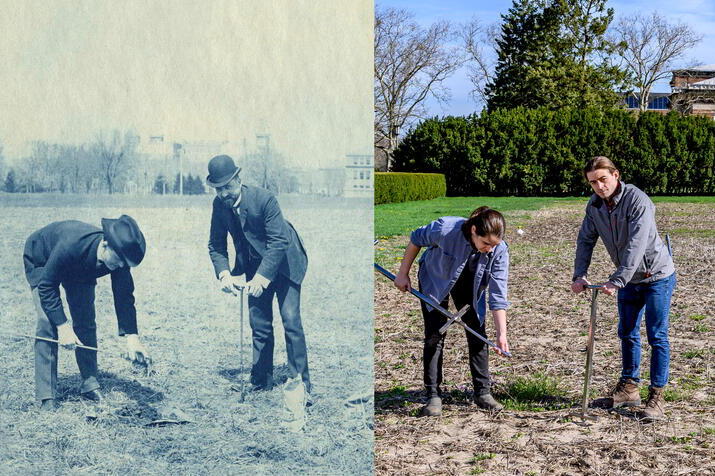
A lot has changed on the University of Illinois Urbana-Champaign campus since its founding in 1867, but a storied plot of land near the south quad has been preserved nearly intact for a century and a half. The Morrow Plots, famed in song and story, represent the oldest continuously running agricultural experiment in North America, and are the second oldest in the world. And this year, they turn 150.
“The Morrow Plots are a huge part of our story in the College of ACES. They’re a direct example of how we live out our land-grant mission, providing evidence-based recommendations that serve the public,” said Germán Bollero, dean of the College of Agricultural, Consumer and Environmental Sciences at Illinois. “We’re so excited to celebrate 150 years of agricultural research and outreach that the Morrow Plots represent.”
It’s not an overstatement to say the Morrow Plots have directly impacted the way Americans farm. When the plots were established, farming was more of an art than a science. But methodical, controlled experiments in the plots proved certain practices — crop rotation and judicious fertilizer use — were winners for boosting crop yield, soil health, and farm profitability.
With the advent of University of Illinois Extension in 1914, another key milestone, results from the plots were shared with farmers to implement across the state and beyond.
“None of this would have been possible without the foresight of early campus leaders, who saw the value of long-term, practical research. This perspective allowed researchers to understand how farming practices shape soil, crops, and ecosystems over decades, not just seasons,” said Adam Davis, head of the Department of Crop Sciences, which oversees the Morrow Plots. “Together, these insights continue to inform strategies that sustain productivity while protecting natural resources.”
Something to Celebrate
In the centennial year of the experiment, the Morrow Plots were designated as a National Historic Landmark. In 2023, the plots’ data were digitized and made available online; the database includes crop hybrid, rotation, planting date and density, harvest date, and yield, as well as fertilizer type and amount.
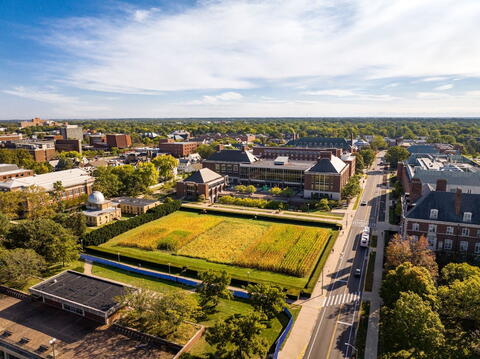
Now in 2026, the college celebrates the Morrow Plots’ 150th anniversary with a revitalized exterior, thanks to a gift from Bayer’s Crop Science division; a dedicated webcam where viewers can check out activities in the plots year-round; and a public tour and symposium scheduled for Oct. 28, along with other events throughout the year.
The October event will also formally unveil the Alma Mater Plots, an 80-acre parcel in the university’s south farms that carries the Morrow Plots’ research focus into the current era. A large focus of the Alma Mater Plots is accounting for tile drainage in cropping system performance, both as a tool and as a conduit for water and nutrient export.
“The Morrow Plots will be completing its 150th harvest this season. What will be the challenges facing agriculture in the next 150 harvests?” said crop sciences associate professor Andrew Margenot, director of the Morrow Plots and the Alma Mater Plots. “While we cannot anticipate the nature and extent of these challenges, we can design a long-term experiment that expands on the knowledge built from the Morrow Plots in a way that can flexibly address the challenges to come. In other words, it’s the ‘Morrow Plots 2.0.’”
Sign up for updates about the revitalization project and anniversary events. To learn more about supporting this legacy and helping shape the next 150 years of agricultural innovation, please contact the College of ACES Office of Advancement at acesadvancement@illinois.edu or 217-333-9355.
Research and Extension in the College of ACES are made possible in part by Hatch and Smith-Lever funding, respectively, from USDA’s National Institute of Food and Agriculture.