Student earns competitive fellowship for research on corn’s defense against bacteria
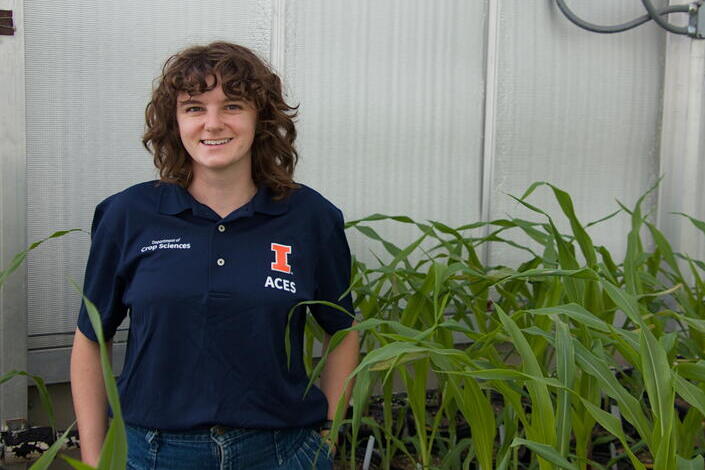
Peyton Sorensen, a third-year doctoral student at the University of Illinois Urbana-Champaign, has earned a predoctoral fellowship from the U.S. Department of Agriculture’s National Institute of Food and Agriculture to fund her research.
The Predoctoral Fellowships Program Area Priority helps develop new scientists and professionals to enter food and agricultural research, education, or extension fields. It aims to cultivate the future leaders who will solve the emerging agricultural challenges of this century.
The fellowship is competitive, with only 49 recipients this year. Sorensen, who is in the Department of Crop Sciences at the College of Agricultural, Consumer and Environmental Sciences, said she had a moment of disbelief when she first saw the acceptance email.
“I remember I jumped up, screamed a little bit, and then ran to get my mentor and tell her,” Sorensen said.
The funds will help support her research for the next three years.
Her research focuses on understanding how plants protect themselves against pathogens. Just as humans have immune systems, plants have various ways to defend themselves from pathogens. Sorensen looks specifically at corn and two of its bacterial pathogens: Xanthomonas and Clavibacter, which cause bacterial leaf streak and Goss's bacterial wilt and blight, respectively.
Sorensen and her faculty mentor, Tiffany Jamann, hope to understand and increase corn’s innate resistance to these diseases, reducing the need for chemical pesticides.
Different tissues in the corn plant have different responses to disease, which Sorensen compared to a medieval castle: the defense mechanism would be different at the drawbridge than further into the castle. Likewise, corn — and other plants — have different responses depending on the location of the infection.
To understand the corn’s response, Sorensen inoculates specific tissues of the crop with bacteria. One to two weeks later, she measures the lesions and the amount of leaf that is diseased. She also studies the plant’s genetic makeup to understand what is happening in different parts of the crop.
Sorensen’s overarching goal is to understand the crop’s resistance genes. With that information, breeders can then create crops more resistant to bacterial infections. Growers can use those varieties in their fields. Sorensen said it’s also possible to maintain food security if they can alter the crops to be more resistant.
Sorensen has some help from Jamann and undergraduate students she mentors. Mentoring has been one of the most rewarding parts of her research.
“I was really lucky when I was an undergraduate because I had some great research opportunities,” Sorensen said. “It’s so great to be able to give that to other students, to get to see them grow and learn and to get a glimpse of who they will become.”
She shares the same perspective on her research. While she is focused on corn, her future findings may have a wide net of possibilities. Corn serves as a model crop, similar to how mice serve as a model animal.
“By understanding how pathogens interact with corn, we can then translate that into other cropping systems,” Sorensen said. “The things that people have found — genes and systems — in corn, they have been able to find similar things in other crops. So, I’m hoping the research I’m doing right now is something that could get translated.”