EPA invests nearly $1M in Illinois research to improve water quality, boost local farm economies
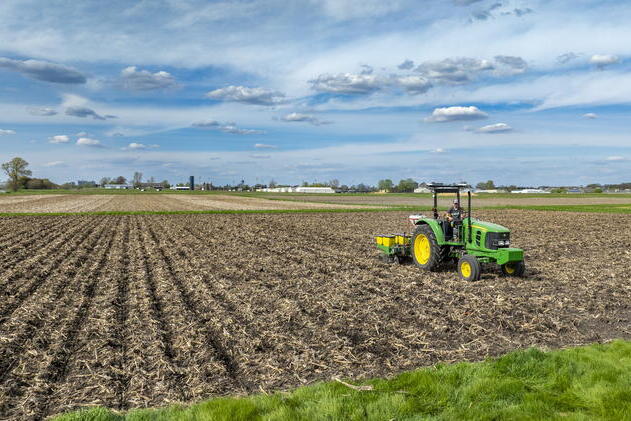
Farmers are struggling with high input costs, low grain prices, and razor-thin profit margins. A new project at the University of Illinois Urbana-Champaign, with funding from the U.S. Environmental Protection Agency, aims to help. By experimenting with drainage water recycling, the team hopes to reduce nutrient losses, improve water quality, boost local farm economies, and avoid harmful algal blooms in the Gulf.
The research team received a $993,940 grant from the EPA for their five-year project titled “Illinois Water Recycling for Gulf Nutrient Reduction.”
“We will conduct field experiments at the University of Illinois South Farms to evaluate nitrogen and phosphorus losses, crop yield, and soil water dynamics. We will also integrate crop modeling, remote sensing, and machine learning to evaluate the potential benefits of this practice across Illinois and investigate its economic feasibility for farmers,” said principal investigator Luciano Alves de Oliveira, assistant professor in the Department of Agricultural and Biological Engineering, part of the College of Agricultural, Consumer and Environmental Sciences and The Grainger College of Engineering at the U. of I.
EPA selected 24 awardees for their Gulf Watershed Projects for Water Quality and Local Economies.
“Researchers are stepping up with forward‑looking solutions to protect our waters and strengthen local economies. EPA is proud to support projects that pair nutrient‑reduction strategies with cutting‑edge technologies. These grants empower farmers and local partners to test scalable innovations that improve water quality, reduce harmful algal blooms, and deliver long-term economic benefits,” said Anne Vogel, administrator for EPA Region 5 (which includes Illinois), in an EPA press release.
The U. of I. project will run from 2026 to 2031 in Champaign County. Crop simulation modeling integrated with satellite remote sensing and machine learning will scale results to millions of acres across Illinois.