Envisioning the next 150 years of crop research with the Alma Mater Plots
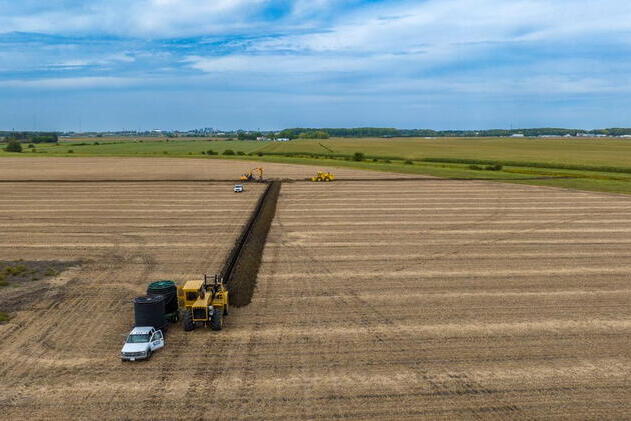
A couple of miles south of the main quad at the University of Illinois Urbana-Champaign, a remarkable agricultural experiment is taking shape. The so-called Alma Mater Plots are unique in their setup — with 64 one-acre plots, each individually tile-drained, it’s the largest experiment of its kind anywhere. And, to maximize the value of the experiment to Illinois and Midwest agriculture, scientists are teaming up with farmers in deciding what, exactly, to study.
“I was trained in an international ag development context in eastern Africa and South America, where we’d roll up to a region and spend a week or more acclimating. During that time, we’d just shut up and listen to understand what people perceive as problems. I thought, we do this a lot in international ag development, but why not here? In my opinion, you just do better science if you listen to the people who work the land,” said Andrew Margenot, director of the Alma Mater Plots, the Morrow Plots, and professor in the Department of Crop Sciences in the College of Agricultural, Consumer and Environmental Sciences at U. of I.
Margenot’s philosophy explains why the plots have been laid out for two years, but long-term experimental treatments have not yet been finalized.
The research team has spent the last year assembling a diverse advisory board and seeking input directly from Illinois agriculturalists. Ping-ponging across the state, they’ve conducted over a dozen focus groups to date — attended by over 140 farmers — and they’re still going.
Margenot has plans to gather feedback from farmers, as well as industry and policy stakeholders, through the end of 2026.
Sanjay Sofat, environmental policy director for the Illinois Farm Bureau, is on the advisory board for the Alma Mater Plots. He appreciates Margenot’s thorough approach to information gathering from farmers.
“There’s a huge disconnect around the realities of farming. People make comments like, ‘Hey, farmers should do xyz,’ without really understanding what it entails to adopt new practices,” he said. “Farmers have to worry about and assess risk around financing new equipment, weather constraints, and so many other issues. By designing this experiment based on farmers' input, we hope farmers will feel more comfortable adopting practices that benefit the land and their bottom lines.”
Morrow Plots 2.0
The Alma Mater Plots are designed to carry the tradition of the historic Morrow Plots forward for future generations. Celebrating their 150th year in 2026, U. of I.’s Morrow Plots are the second-oldest continuously running agricultural experiment in the world.
“The whole point of the Morrow Plots was to address questions that Illinois farmers had, as part of our land-grant mission,” said ACES Dean Germán Bollero. “That's how it really began. They invited farmers to campus for extension days at the Morrow Plots. It was a big deal for the farm community. We’re trying to bring that back for the next 150 years.”
The current iteration of the Morrow Plots — a single acre with 24 subplots — can fit inside one of the 64 Alma Mater subplots. With enough land set aside to eventually expand to 75 or more plots, the Alma Mater Plots represent a more realistic scale and afford researchers much greater statistical power to make confident management recommendations.
Emerging themes
While the researchers are still gathering farmers’ opinions about what to test, several themes are emerging, including water quality, soil health, regenerative practices, and profitability.
A key feature of the Alma Mater Plots is their individually monitored drainage tiles, which allow researchers to test the impacts of cropping systems, inputs, and management practices on water quality in real time. Since the plots were established in 2024, the researchers have been collecting baseline data on water quality.
“If we are going to farm some of the wettest soils in the country, we need tile. But we are very passive about tile — we tend to put them in and walk away. Farmers could be managing water a lot more intentionally,” Margenot said. “Are there trade-offs to tile drainage? Absolutely. Let’s optimize those trade-offs, in particular increasing nitrogen fertilizer use efficiency and profitability, and minimizing nitrate losses.”
Margenot also wants to design the experiment in a way that helps farmers grow more profitably. For example, testing whether they can avoid spending on herbicides and fertilizers by growing legume cover crops.
Reducing herbicide use is on Jude Holscher’s mind. Farming in Crawford County with his dad, Holscher is a member of the Illinois Farm Bureau and his county’s Soil and Water Conservation District. He learned about one of Margenot’s focus groups, and figured, “Why not?”
“They didn't have any decisions made on what they wanted to do with the research plots, so they were just getting insight from different farmers in the area,” he said. “I didn't hold back on what I thought, and said I wanted to see more regenerative concepts in a U. of I. research plot.”
Regenerative practices just make sense to Holscher as he looks to the future.
“My boys are 2 and 4. They really changed my perspective on a lot of things that we're doing. If you're on a tractor, they want to be with you. But they don't get to ride in the [herbicide] sprayer because of what you're surrounded with. I told my 4-year-old I'm hoping that by the time he's old enough to run this sprayer, we won't have to use it anymore. That's really a long-term goal.”
Beth Baranski volunteers as the organizing secretary of the farmer-led Jo Daviess County Soil and Water Health Coalition. She attended a focus group on behalf of her organization, whose members are also increasingly interested in regenerative practices.
“Transitioning from conventional to regenerative practices has challenges and can be a daunting move for farmers. We have a slowly growing set of early adopters in Jo Daviess County, but believe the practices can help farmers broadly,” she said. “We think it's important that regenerative practices be represented in the plots to allow researchers to understand and compare the benefits so they can share this with the many farmers who rely on the university for guidance.”
The next 150 years
The plots haven’t lain fallow while the researchers have been gathering information. All are planted in corn for a 3-year Foundation for Food and Agriculture Research study to test-drive a proposed protocol for using new enhanced-efficiency fertilizers.
But when all of the focus group feedback has been synthesized, and the first long-term experimental treatments begin, Margenot says there will still be aspects not set in stone.
“We’re designing the treatments such that the specifics can be modified — like the Morrow Plots have been innumerable times — to reflect the reality of the ever-changing agricultural landscape,” he said. “We don’t know what the questions will be in 50 years, much less 150, but we’re planning for the Alma Mater Plots to keep helping farmers answer those questions for at least that long.”
Register for the Alma Mater Plots tour on Aug. 11.