U of I part of $22.5M project to communicate with, program crops to respond in real time
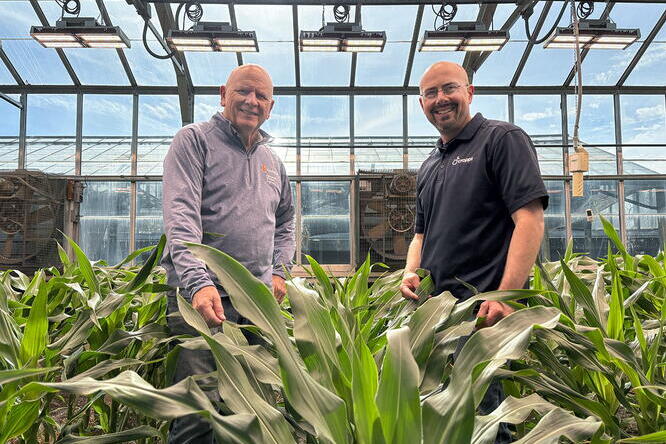
Scientists at the University of Illinois Urbana-Champaign and five other research institutions are five years into a futuristic $25 million project that allows people and plants to communicate and collaborate to meet environmental challenges. Now, the Cornell University-led Center for Research on Programmable Plant Systems (CROPPS) has been renewed by the National Science Foundation for another five years, with an additional $22.5 million grant.
John Reid, co-principal investigator and Illinois campus lead, is helping coordinate the university’s contributions to CROPPS, which bring together crop science, artificial intelligence, and agricultural engineering to develop programmable plants and integrate them into future agricultural production systems.
“Precision agriculture has traditionally focused on using technology to observe crops and make better management decisions. Programmable plants open the door to something fundamentally different: crops that can communicate their needs and respond to targeted interventions.
“By combining plant biology with artificial intelligence, sensing, and automation, we envision agricultural systems where plants and machines work together to improve productivity, efficiency, and resilience,” said Reid, executive director of Illinois’ Center for Digital Agriculture. He is also part of the College of Agricultural, Consumer and Environmental Sciences and The Grainger College of Engineering in his role as a research professor in agricultural and biological engineering and computer science.
Anthony Studer, associate professor in ACES’ Department of Crop Sciences, co-leads a CROPPS research theme with Arjun Khakhar at Colorado State University. Their teams are designing crops whose root and leaf structure can be changed mid-season to maximize productivity. For example, if water availability becomes limited during the growing season, root growth can be adjusted to access hidden water reserves. Likewise, dynamic changes in a plant’s canopy could allow farmers to suppress weeds with wide leaves early in the season, while optimizing for capturing light through a tapered leaf structure later in the season.
“We are really excited about the second phase of the project. In phase one we learned so much about how to design genetic programs to change leaf size. Now in phase two we have the opportunity to test programmable corn plants in the field to see if these designs result in yield gains for farmers,” Studer said. “Eventually we will integrate with the CROPPS plant communication teams to achieve a two-way exchange of information between plants and farmers.”
Read more about the project renewal from Cornell.