Illinois study: How cracks in dry soil impact moisture evaporation
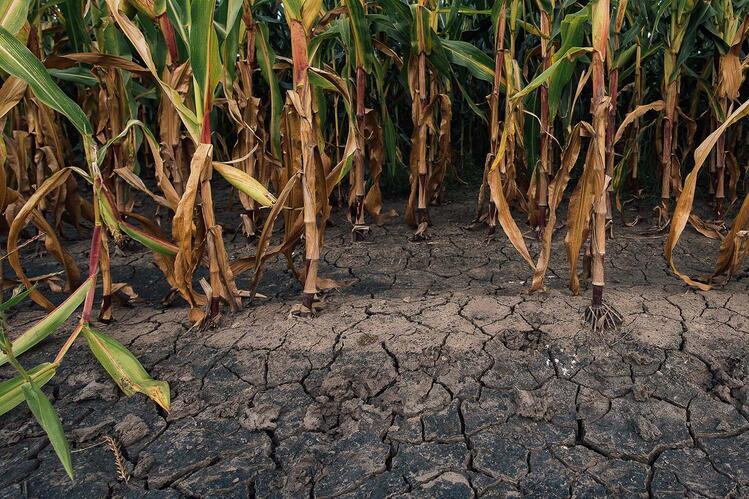
Soils that are exposed to prolonged drought often develop desiccation cracks, which impact soil properties and exacerbate moisture loss through evapotranspiration. A new study from the University of Illinois Urbana-Champaign examines the evolution of soil cracking and how cracks interact with storage and movement of water in the soil. The findings can help improve hydrological models essential for water management.
“As moisture evaporates from the soil, it induces stress. Once this stress exceeds the tensile strength of the soil, the soil breaks and desiccation cracks form. The cracks open additional surface area for moisture to transfer from the soil to the atmosphere, causing soil with cracks to become even drier,” said lead author Kristelle Dela Cruz, a doctoral student in the Department of Agricultural and Biological Engineering, part of the College of Agricultural, Consumer and Environmental Sciences and The Grainger College of Engineering at Illinois.
Soils are generally described based on their texture and structure, explained co-author Maria Chu, professor in ABE. “Texture refers to the percentages of sand, silt, and clay that make up the soil. Structure describes how these different components are arranged into clumps or aggregates. When the soil cracks it affects the organization of components, changing the soil structure.”
The research team built a lysimeter – an instrument which measures the water balance of soil – to replicate field conditions in the lab. The lysimeter contained a column with one cubic foot of silt loess, a soil common in the U.S. Midwest. They added an environmental chamber with temperature control and a tile drain to allow for drainage flow.
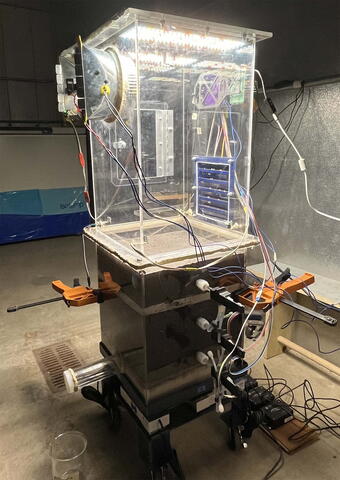
In the lysimeter, the researchers simulated heat wave conditions at 40 degrees Celsius and exposed the soil to multiple cycles of wetness and drying to mimic soil crack evolution.
“We cannot directly measure evaporation, but we can estimate the total loss of water from the soil by tracking the changes in weight through time, which can indicate the amount of water that has been lost from the system,” said co-author Jorge Guzman, research assistant professor in ABE.
The researchers also attached a camera on top of the environmental chamber and monitored the propagation of cracks through time, measuring the area occupied by cracks relative to the total area of the soil surface. They correlated this information with the hydrologic variables observed from the subsurface and evaporation rate.
“Most hydrological models assume soil structure to be static, whereas we're trying to determine how changes in soil structure affect the hydrologic variables over time. This will be helpful in assessing drought impacts, as well as the soil water availability,” Dela Cruz said.
Once soil cracks have developed, they tend to remain stable over time if there is no intervention, permanently affecting the soil’s ability to retain moisture.
“Soil without cracks is more protected against water loss. We can see from our data that the cracks accelerate the process of water transfer from the soil to the air. Then, the soil area that contacts the air becomes drier, and it changes the dynamic of how water redistributes in the soil. Eventually there is a decrease in evaporation, but that’s because the water is already gone,” Guzman explained.
“While the experiment focused on bare soil, it will also be important to evaluate the impact of vegetation and transpiration from plants,” he added. “What happens once you have soil cracks and vegetation, and the soil and plants are competing for water?”
The paper, “Desiccation cracks and their impacts on bare soil evaporation,” is published in Soil & Tillage Research [DOI: 10.1016/j.still.2026.107207].
Research in the College of ACES is made possible in part by Hatch funding from USDA’s National Institute of Food and Agriculture. The study was also supported by a seed grant provided by the University of Illinois Urbana-Champaign Department of Agricultural and Biological Engineering and the University of Illinois Urbana-Champaign Campus Research Board.