How ACES is addressing food insecurity on campus
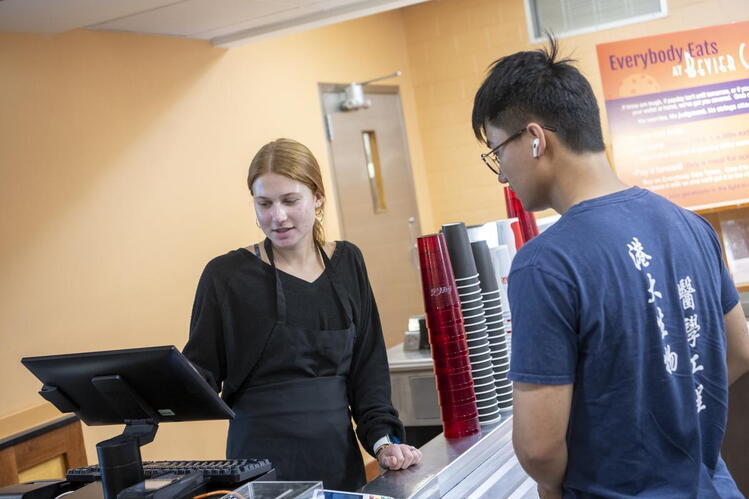
With tens of millions of Americans reporting food insecurity — difficulty accessing enough food for an active, healthy life — it shouldn’t come as a surprise that University of Illinois Urbana-Champaign students are among them. Two different 2025 surveys show that between 18 and 36% of undergraduates on campus may be food insecure, potentially impacting their academic success.
“If students are worried about where their next meal is coming from, they may not be able to concentrate as much on assignments and other academic expectations,” said Krystal Hodge, assistant professor in the Department of Food Science and Human Nutrition (FSHN), part of the College of Agricultural, Consumer and Environmental Sciences at U. of I. “Even if students technically have enough food, they may be substituting cheaper foods for more nutritious ones. Those choices don’t necessarily support their nutritional needs in the long term.”
Hodge and graduate student Michelle Agyemang performed a survey in spring 2025 that showed, of 457 survey respondents across campus, about 36% were food insecure. Further, an additional 22% were “marginally” food insecure, meaning they were worried about having enough to eat at least some of the time.
An ACES-only survey was performed around the same time. Of the 606 undergraduates enrolled in ACES majors who responded, 110 (18.2%) reported experiencing food insecurity to varying degrees.
Associate dean for diversity, equity, and inclusion Elizabeth Olson, whose office oversees student access and other supports in ACES, says it’s a major concern that over 100 students in the college regularly face food scarcity.
“Students should be able to focus on learning, discovering their potential, and building their futures without having to worry about whether their basic needs will be met,” she said. "A strong college community is one where students don't have to navigate challenges alone. Supporting students and ensuring they can eat isn't separate from our commitment to their academic success; it is an important part of it."
Fortunately, ACES has some expertise in the realm of food, nutrition, and health. Not only has the college made foundational research discoveries in these areas over its 160-year history, it also houses University of Illinois Extension, which positions professionals in every county across the state to help residents find healthy foods and stretch their food dollars through its new Health and Community Wellness program, launched in October 2026.
Here on campus, ACES is pioneering and contributing to multiple programs designed to alleviate hunger among students and staff, joining other university programs with similar aims.
Everybody Eats
Despite working around food every day, it never occurred to Carter Phillips, instructor and chef for the hospitality management major in FSHN, that his student workers or customers could face food insecurity. Phillips runs Bevier Cafe, a student-operated cafeteria located in Bevier Hall that gives FSHN students real-world experience with menu planning, meal preparation, front-of-house operations, and more.
“Around 2020, a student of ours shared a story about walking through campus dizzy because it had been so long since he’d had something to eat. It kind of floored me,” Phillips said. “Our students are some of the brightest in the world. They pay hefty tuition dollars to be here. I certainly didn’t think food insecurity could be a problem here on campus, but it was, and it was right in my face.”
Phillips and his hospitality management colleagues soon launched a program called Everybody Eats, a pay-it-forward model where paying customers and donors can round up or contribute toward tokens, each of which represents the cost of a meal. When someone without the necessary funds comes down the line, they can grab a token out of the jar and hand it over at checkout, no questions asked.
“It's the butterfly effect where small donations get added up toward tokens. That token buys the food that fuels the student to pass the exam, which gets them the degree, that gets them the job or drives them into academia to solve some of the world's biggest problems,” Phillips said. “So it's a very small, but very meaningful way for the community to support itself, and we really focus on that.”
Inspired by Phillips’ initiative, University Housing followed suit, spinning Everybody Eats into a campuswide food assistance program. At two of Housing’s dining halls — the Student Dining and Residential Programs building and Illinois Street Residence Halls — students can pick up free daily hot and cold meals packaged to go, no ID required.
Give to the Bevier Cafe Everybody Eats fund
An ecosystem of service and learning
Nicki Engeseth, professor and head of FSHN, noted, “People might think that having enough money to attend the University of Illinois must guarantee food security, but we know that is not the case. We are hoping to raise awareness and build solutions across campus and beyond. That’s a big focus in our program.”
A cadre of researchers in FSHN and other ACES departments are actively investigating the impacts of food insecurity, food policy, and related topics. They’re also training students to make a difference.
When Toni Gist, clinical assistant professor in FSHN and award-winning teacher, noticed one of her students struggling to stay alert in her Contemporary Nutrition class, she reached out. Learning that the student hadn’t eaten for a full day, Gist jumped into action.
Initially, she and her husband ransacked their pantry, bringing extras to class. Then, she began buying and bringing snacks for the hundreds of students sitting in her Foellinger Hall lectures. That soon became cost prohibitive, so she convinced an area grocery store to donate items that were close to their expiration, hauling them to campus every week. Today, she continues bringing snacks to class and stocks a small grab-and-go food pantry outside her office in 439 Bevier Hall.
“I recognized the irony of asking students to focus on food and nutrition when some may be sitting in the classroom with empty stomachs,” she said. “The idea is to make food accessible without requiring students to explain their circumstances or ask for help.”
Aware that the need likely extended beyond her classes, Gist devised a way to feed students across campus and provide service-learning opportunities for her own students. She asked her class to design and host a campus food drive, with the goods going to the Food Assistance and Well-Being Program, located in the Instructional Kitchen in the Activities and Recreation Center. The program offers a free grocery-shopping style experience for anyone with an i-card and is often staffed by FSHN’s dietetics students.
Gist has also joined forces with Carter Phillips at Bevier Cafe to expand support for the Everybody Eats initiative. The two co-authored a grant proposal that resulted in a $1,000 donation from the McKinley Foundation, helping provide additional meals.
Food produced on campus, shared on campus
Recognizing that people experiencing food insecurity often don’t have access to fresh, healthy foods, ACES contributes locally grown produce and meat to campus and community initiatives.
Livestock raised and butchered by the Department of Animal Sciences’ Meat Science Laboratory offers research and learning opportunities for faculty and students, and some of the meat is sold to Campus Recreation to supply the Food Assistance and Well-Being Program. The lab also processes meat from the State Fair’s Sale of Champions in partnership with the Illinois Department of Agriculture and Feeding Illinois, this year providing 944 pounds of fresh cuts to local food banks.
Much of the produce offered at the Food Assistance and Well-Being Program is grown at the Sustainable Student Farm, part of the Department of Crop Sciences. The farm also contributes produce to Bevier Cafe and other campus dining facilities — and therefore, Everybody Eats.
Both the Meat & Egg Sales Room and the SSF accept food vouchers distributed through Student Affairs.
The challenge: Accepting assistance
When FSHN Assistant Professor Krystal Hodge and graduate student Michelle Agyemang asked food insecure undergraduates if they knew about food resources on campus, nearly 80% said yes. However, the majority of these students (59%) weren’t using them.
“That was shocking to me,” Hodge said. “We’re still analyzing those data, but we’re trying to understand who is and isn’t engaging with the available resource and why.”
The research team found correlations between food insecurity and financial aid eligibility, parental support, and international status, but, so far, there’s no overwhelming pattern explaining the barriers preventing students from using available resources. Still, Hodge thinks this exploratory research could be useful in designing interventions.
Building on this research, ACES is taking steps to strengthen how students connect with existing support. Hodge was recently selected as a Faculty Fellow with the ACES Office of Diversity, Equity, and Inclusion to advance this work through a project adapting Illinois Extension’s Find Food IL Navigator program for the university setting. For this fellowship, Hodge will develop a model for training faculty, staff, and student support personnel to serve as trusted Food Navigators who can help students understand available resources, navigate assistance options, and overcome barriers such as uncertainty about eligibility or stigma.
“The goal is to move beyond simply making resources available to ensuring students feel informed, comfortable, and supported in accessing them,” Hodge said.
To support food security programming and initiatives in the College of ACES, consider a gift to the Robert J. McGorrin Food Security Endowment Fund or contact the Office of Advancement at acesadvancement@illinois.edu or 217-333-9355.