How high turnover rates in Tanzania’s agro-dealer sector affect farmer fertilizer adoption
Smallholder farmers in sub-Saharan Africa adopt agricultural inputs including fertilizer at a low rate, contributing to low agricultural productivity. Previous research has shown that insufficient information and distrust in the quality of products for sale in local markets are among the reasons for low rates of fertilizer adoption and application. In a new study, University of Illinois Urbana-Champaign researchers examined the agricultural marketplace in Tanzania, finding that frequent turnover among local agro-dealers affect farmer perceptions of product quality and have implications for broader market functioning.
“Agricultural inputs are experience goods: you don’t know if a product is of good quality until after purchase and use. For fertilizer, you might not know for several months because the plant’s agronomic response to the application only becomes observable over time. In markets with such information asymmetries, economists have shown that consumers tend to rely a lot on the reputation and trust of sellers as a proxy for the unobservable quality of the product,” said co-author Hope Michelson, professor in the Department of Agricultural and Consumer Economics, part of the College of Agricultural, Consumer and Environmental Sciences at U. of I.
Michelson’s research team has been collecting data in Tanzania’s Morogoro region for a decade, gaining insights into agro-dealer operations, soil quality, farmer production systems, and farmer perceptions of agricultural inputs. The team has established that a common perception among smallholder farmers in Tanzania — as in other parts of the world — is that fertilizer for sale in the market is of bad quality, missing important nutrients that lower its agronomic effectiveness.
The puzzle is that, despite widespread perceptions of quality problems, independent testing across multiple studies and laboratories shows that fertilizer sold in the region is consistently of good quality, Michelson said. Understanding — and ultimately correcting — farmers’ misperception about fertilizer quality remains a persistent and important challenge for both policy and research.
The Illinois researchers have gone back to the same markets again and again, surveying agro-dealers and sampling and testing their fertilizer. Over the years, the team noticed that agro-dealers had a very high rate of exit from the market; higher than other small businesses operating in the region.
“We set out to document these rates of agro-dealer turnover and to benchmark them against what we observe in other developing countries among micro and small enterprises. We wanted to understand the drivers and motivations for these high entry and exit rates, and to explore if there was a systematic relationship between agro-dealer turnover and farmer beliefs about fertilizer quality in these markets,” said corresponding author Alix Naugler. She conducted the research as a master’s student in ACE and is currently pursuing a doctoral degree in applied economics and management at Cornell University.
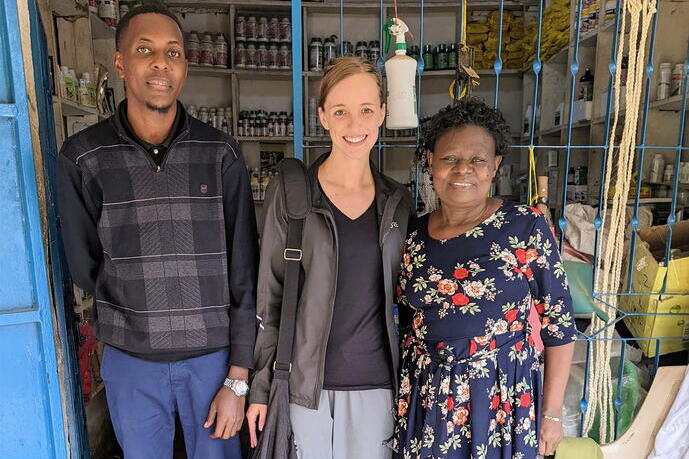
Naugler conducted field work in Tanzania with local collaborators, including co-author Christopher Magomba, professor at the Sokoine University of Agriculture, and a team who helped with data collection.
The researchers traveled across the region to speak with farmers and agro-dealers; they also conducted phone surveys with agro-dealers already in their database from previous studies.
The new research documents very high annual agro-dealer entry and exit rates: 33 and 17 percent, respectively. These rates are more than double the typical turnover rates for non-agricultural micro and small enterprises in low-income countries.
Next, the researchers investigated why agro-dealers are entering and exiting the market at such high rates. Do agro-dealers just enter the market only when they have no better options and subsequently exit when a new opportunity arises? Do they treat these businesses as a backup strategy for earning income? The survey data showed something very different.
“The agro-dealers in our sample are what we call ‘optimistic entrepreneurs’ — they are educated and trained in the agricultural sector, and they enter with the intent to operate for the long run. They want to sell agricultural inputs to smallholder farmers. But strong competition is driving them to exit at high rates,” said co-author Sarah Janzen, an associate professor in ACE.
To explore the association between high agro-dealer turnover rates and farmer perceptions of agricultural input quality, the researchers explored several scenarios with farmers: they asked each farmer to rate the agricultural input quality of their current agro-dealer; they then asked about the expected agricultural input quality of a hypothetical new market entrant.
“We find that farmers who usually purchase agricultural inputs from the same agro-dealer have an established relationship. They trust them. However, these farmers expect new market entrants to provide lower-quality agricultural inputs,” Naugler said.
The researchers also found that when agro-dealers exit the market, farmers expect overall fertilizer quality in that market to improve. They suggest this is happening because farmers believe that “bad agro-dealers” — suppliers of low-quality products — are the ones leaving. This is in spite of the research showing there are no “bad agro-dealers,” in the sense of selling bad fertilizer. But these incorrect perceptions among farmers continue to persist and evolve.
“It’s important to understand these entry and exit dynamics. Farmers cannot observe fertilizer quality at the point of purchase, so they are using information they're observing in their own markets about agro-dealer operations to inform their beliefs about quality. This has consequences for which agricultural inputs they choose to purchase and adopt,” Michelson said.
She adds that the research points to the important but overlooked role of agro-dealers. They are not just selling products but are also providing information and guidance for farmers, complementing guidance from under-resourced and over-extended government extension services.
“Agro-dealers share agricultural information with farmers, including which brands to use and how to apply the product. Ensuring these businesses are financially sound, and that they have the technical expertise to serve farmers locally can ultimately strengthen agricultural productivity in the region,” Naugler concludes.
The paper, “Firm Turnover Under Asymmetric Information: Tanzania’s Agro-dealer Sector,” is published in the American Journal of Agricultural Economics [DOI: 10.1002/ajae.70093].
Research in the College of ACES is made possible in part by Hatch funding from USDA’s National Institute of Food and Agriculture. This study was also supported by financial assistance from the U. of I. College of ACES Office of International Programs, the Private Enterprise Development in Low Income Countries programme at CEPR and FCDO, and the University of Sussex Impact Award and Opportunity Funds programs.