Small Grains Lab receives three USDA grants in support of oat-breeding research
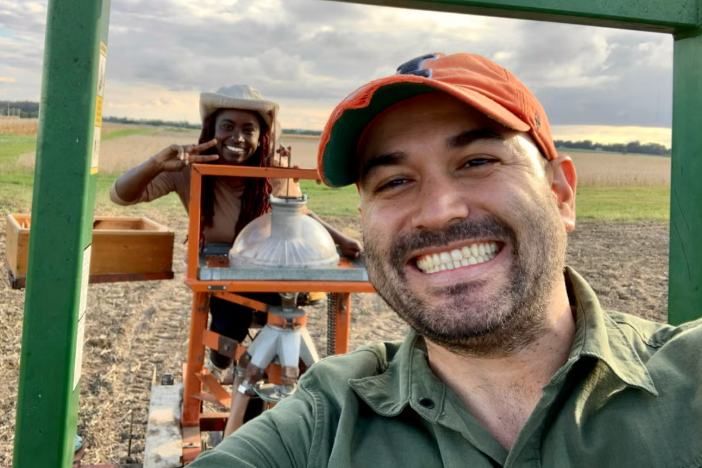
The Small Grains Lab at the University of Illinois Urbana-Champaign has received over $1 million in USDA grants to improve the sustainability and nutritional value of oats in the Midwest.
The lab received three grants in total, including $800K as part of a $10 million, multi-state grant from the AFRI Strengthening Agricultural Systems (SAS) program in the USDA’s Agricultural and Food Research Initiative (AFRI), led by the University of Wisconsin. The grant will primarily support the Small Grains Lab’s development of heat-resistant oats, which are intended to improve production within Illinois’ climate.
The other two grants, from the USDA Agricultural Research Service (ARS), fund efforts to identify and develop oats that can resist Barley Yellow Dwarf Virus, a viral disease that often reduces crop yield, and to use data-driven tools to increase the nutritional value of oats.
“It's not easy to find this kind of funding for crops like oats, so this has been an extremely good outcome for the oat community. We really hope it will help keep this crop alive in the Midwest keep it from disappearing from our agricultural landscape,” said Juan Arbelaez Velez, head of oat breeding at the Small Grains Lab and associate professor in the Department of Crop Sciences, part of the College of Agricultural, Consumer and Environmental Sciences at U. of I.
According to Arbelaez Velez, oats were a popular commodity around a century ago, primarily used as animal feed. They declined in prominence with the rise of mechanization and rotations built around high-value cash crops like soybeans. Recently, however, oats have seen a resurgence as a food-crop because of their high nutritional value, especially for cardiovascular health.
Besides meeting growing consumer demand, fostering oat production in the Midwest can promote domestic food security. Arbelaez Velez says a significant share of the oats consumed in the U.S. currently come from Canada, and increasing domestic production can reduce dependence on exports. Local oat production also promotes sustainability: adding oats to crop rotations breaks often-destructive pest and disease cycles and improves soil health by adding nutrients and organic matter.
Despite their economic and environmental benefits, oats can be challenging to grow because of climate requirements and disease like BYDV. The Small Grains Lab intends to tackle these issues with the three new grants.
“We're hoping to release three varieties with BYDV resistance and higher nutritional quality by the end of this year or early 2027,” Arbelaez Velez said. “And as we work with our partners from out of state, we hope to identify advanced germplasm with, for instance, higher beta-glucan content, a compound that benefits cardiovascular health.”
The U. of I. oat breeding program, which has run for over 70 years, has made significant research progress surrounding the planting and use of oats. More importantly, it has released oat varieties suited to the unique needs of Midwestern growers. The Small Grains Lab plans to continue this work with the new grant support and its unique position as a Midwest oat breeder.
“We're really grateful to the federal government for trusting us with this project and I'm very grateful to my colleagues at all these different universities that have been working really hard to keep this crop going,” Arbelaez Velez said. “There are only five breeders in the entire region, in Minnesota, North Dakota, South Dakota, Wisconsin, and Illinois. It's very rare to receive such great news, so we're hoping this can help us advance our work with oats for many more years to come.”
Research in the College of ACES is made possible in part by Hatch funding from USDA’s National Institute of Food and Agriculture. This study is also supported by funding from USDA AFRI (USDA-NIFA-AFRI-011677) and two ARS Non-Assistance Cooperative Agreement awards (58-2050-6-013 and 58-2050-6-057).
Arbelaez Velez is also affiliated with the Illinois Global Institute at U. of I.