Five-time Illinois graduate announced as 2026 ACES commencement speaker
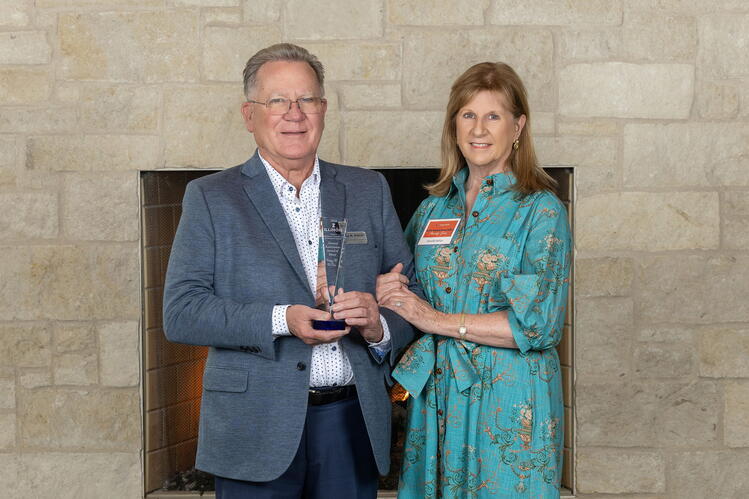
Editor's Note: This story was updated on April 22 to better reflect the five degrees Gregg BeVier earned from the University of Illinois Urbana-Champaign.
At this spring's commencement, ACES graduates will hear from a five-time Illinois alum whose impact has been felt around the world. Veterinary scientist and business leader Gregg BeVier will share how he leveraged his enduring passion for animal science to develop innovative technologies and help feed hungry families across India and Africa.
Although his work has been instrumental in increasing global food security, BeVier’s story has a humble beginning.
During high school in the Chicago suburbs, BeVier took a job in a hospital. It quickly became clear that healthcare wasn't the right fit, but he could see himself pivoting to work with animals.
So, in the fall of 1977, BeVier arrived on the University of Illinois Urbana-Champaign campus, majoring in agricultural science in the College of Agricultural, Consumer and Environmental Sciences and beginning his path to becoming a veterinarian.
Outside of classes, BeVier picked up a part-time job at the university’s swine facility, cleaning surgery rooms. It was hardly glamorous work, but it became a turning point for him. It was his first real taste of what would become a career in swine production.
But when BeVier applied to the University of Illinois College of Veterinary Medicine during his junior and senior years, and yet again after graduating in 1975, he was rejected. Yes, three times. Undeterred, BeVier enrolled in a master’s program in animal science. During that program, he applied to veterinary school once more. Another rejection.
With his master’s degree in hand, BeVier accepted a job in Nebraska working in pig genetics and reproduction. He submitted one more VetMed application, and on his fifth try, he received his acceptance letter from VetMed. Although he’d just gotten started in Nebraska, he eagerly moved his family back to Urbana to begin training as a veterinarian.
“The concept of persistence has gotten me to where I am today,” BeVier said.
Along the way to his DVM, he earned a bachelor's degree in Veterinary Science in 1980.
During veterinary school, BeVier secured an assistantship that focused on swine sperm quality. This would become another turning point, setting him on a path that would later help international aid foundations develop investment portfolios that could provide more consistent protein sources for food-insecure households.
Before that could happen, BeVier graduated from vet school in 1982. He worked first in Nebraska and then in Kentucky for a pig genetics company, for more than a decade. Pretty soon, however, he felt a familiar itch.
“I felt my career was going stagnant. Going back to school was an important next step in growing my career, and Illinois was the place to do it,” he said. “I wanted a career that impacted millions of animals, not just a few. I needed to learn more about business and finance.”
BeVier returned to the U. of I. to pursue his fifth degree. He earned a master’s degree in business administration in 1992, which opened the door to a role in international sales at the Pig Improvement Company. He would go on to serve as president of PIC from 2001 to 2003 and also served on the Board of Directors for five years.
Next, BeVier searched for a job that would fulfill his desire to impact animals globally. He bought and sold companies related to agriculture production that “really started to make a difference.”
Out of the blue, BeVier received an invitation to interview with the Gates Foundation. He was brought on to work in agricultural development to create a livestock giving program for Africa and India.
In the Indian communities he visited, BeVier observed that milk from cattle was often both the main source of protein and an important source of income. Because many people practice Hinduism and do not consume beef, families depend heavily on dairy production. This made the birth of female calves especially important, as male calves offered little economic value.
“We needed to make sure they were getting female calves,” BeVier said.
He connected with a Texas-based company, STgenetics, that specializes in sex-sorted sperm for dairy cattle, helping increase the chances of female births.
“This technology can change lives,” BeVier said.
Through his persistence in chasing a career that could truly impact global agriculture, and his willingness to do whatever it took to serve these communities, BeVier is making a difference on a global scale, something he had set his heart on since his time in vet school.
Now, BeVier works as the chief of staff for STgenetics, working with various livestock species. What started as an idea to help the disadvantaged has grown into three labs across India and two mobile labs. These labs produce millions of semen straws per year to be used for artificial insemination of cows. The goal is to help Indian farmers produce healthier cows for the production of milk, providing greater income and food security for those who make less than $2 per day.
“This is the ultimate job of my career. I could do all of the things I have learned (reproduction, genetics, research, and business) and to help those less fortunate. I believe that all lives have equal value and my recent work has helped to reinforce this belief."
Persistence got him to the point in his career where he is making a positive impact globally. And it got him to the stage at the 2026 ACES Commencement ceremony.
His advice to future students: “Get to know your professors, faculty members, and those around you. Take a hold of opportunities and never give up.”