Terrestrial biodiversity grows with tree cover in agricultural landscapes
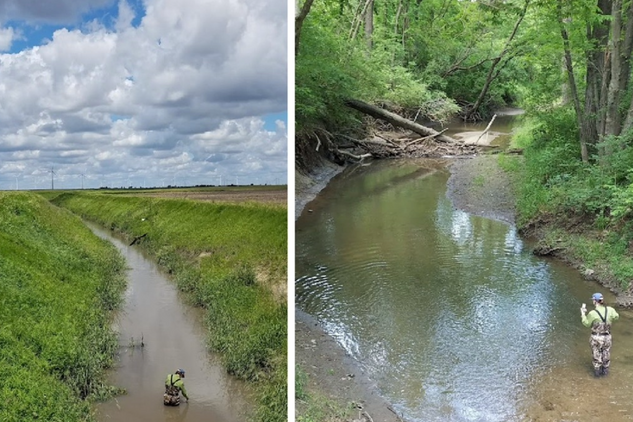
Farmers plant or preserve riparian buffers for various reasons, such as improving water quality, controlling erosion, or maintaining hunting habitat. Now, a new study from the University of Illinois Urbana-Champaign underscores the benefits of riparian buffers to terrestrial biodiversity, finding that for every 10% increase in forest cover, an additional species is present.
“We found raccoon and common snapping turtle DNA all over the place,” said senior study author Eric Larson, associate professor in the Department of Natural Resources and Environmental Sciences (NRES), part of the College of Agricultural, Consumer and Environmental Sciences at Illinois. “But the fact that we found bobcats and big brown bats with our sampling method was exciting, and shows just how much is going on in those riparian buffers.”
The sampling method Larson is referring to — environmental DNA metabarcoding — is one he and fellow ecologists have leaned into in recent decades to detect rare or hard-to-capture species. By extracting DNA fragments from water, soil, snow, or even air, scientists can reconstruct the animals that have traipsed, swam, or flown nearby.
When Larson and Olivia Reves, the study’s first author, decided to study biodiversity in riparian buffers, they already knew the benefits of tree cover for aquatic organisms. For example, shade from overhanging trees protects the water from thermal extremes and creates more favorable fish habitat. But less was known about the benefits of riparian buffers to terrestrial animals in agricultural areas.
To fill this gap, Reves and Larson used eDNA metabarcoding to identify terrestrial species from water adjacent to agricultural land across 47 sites in Central Illinois, varying in forest cover.
“This monitoring tool has been overlooked to identify the benefits of agricultural conservation actions like riparian buffers for terrestrial biodiversity,” said Reves, who recently completed her master’s degree with Larson.
But why sample water to detect terrestrial species?
“If we looked for fish in these samples, we would certainly find fish DNA,” Larson said. “But water in a stream or river incorporates DNA from all of the animals using the surrounding landscape. You dip down to the stream for a drink, and you leave some of your DNA to be detectable downstream.”
After isolating and identifying all of the DNA fragments from the water, the researchers could then look at the relationships between terrestrial diversity and forest cover. Not only did they find an additional species for every 10% increase in forest cover, but sites with complete forest cover supported three times the terrestrial vertebrate species compared to those lacking tree cover. Also, community composition turned over in higher-cover locations.
“We saw a gradient in the animal communities linked with forest cover,” Reves said. “At one end, we saw grassland species — mice, ground squirrels, killdeer — that are adapted to more disturbed environments. In the high forest cover sites, it was a totally different set of species. The fact that we saw forest-dependent species, including southern two-lined salamanders, North American river otters, and ruby-throated hummingbirds, really drives home the idea that riparian buffers are beneficial in agricultural landscapes.”
Reves added that, despite the biodiversity benefits, not all agricultural landowners are sold on riparian buffers.
“Some landowners see them as unkempt or think they bring pests to their fields. But we found a lot of species, like bats, that actually draw pests away or prey on those pests. In addition, riparian buffers can help with soil erosion and water quality,” she said. “I hope our study informs the voluntary and regulatory implementation of forested riparian buffers across the Midwest.”
The study, "Environmental DNA quantifies the terrestrial biodiversity co-benefit of forested riparian buffers in agricultural landscapes," is published in the Journal of Applied Ecology [DOI: 10.1111/1365-2664.70206]. Authors include Olivia Reves, Nick Iacaruso, Mark Davis, and Eric Larson.
Research in the College of ACES is made possible in part by Hatch funding from USDA’s National Institute of Food and Agriculture. This study was also supported by a project funded by USDA’s McIntire-Stennis program [grant no. 7004745].