‘Where the Crawdads Boil’ event partners with Indigenous communities for hands-on conservation
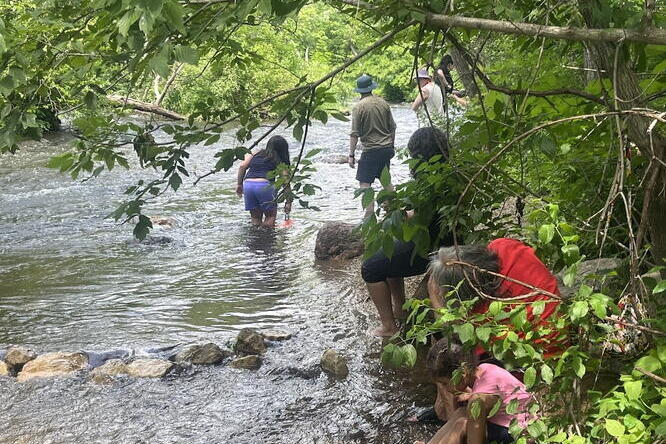
"Take nothing but pictures, leave nothing but footprints.” That’s what kids are usually told on nature walks. But Caitlin Bloomer, aquatic ecologist and teaching assistant professor at the University of Illinois Urbana-Champaign, believes that a more hands-on, land-based approach is needed to improve conservation. So when she traveled to Minnehaha Falls, Minneapolis, this summer to help lead a nature walk for kids, they went home with some invasive crayfish.
Bloomer co-created a unique event, Where the Crawdads Boil, which combined a nature walk with invasive crayfish hunting and a seafood boil in partnership with local Indigenous organizations. Bloomer brought this event to life with her friend Thadd Hall (Mandan and Hidatsa), an adult and family advocate and engagement specialist at Little Earth subsidized housing complex, as well as Hope Flanagan (Seneca), a naturalist, storyteller, and community outreach specialist at Dream of Wild Health sustainable farm.
Bloomer hopes that culturally specific, land-based programming will help revive the bond between people and crayfish, supporting conservation efforts.
“Crayfish are special,” Bloomer said. “They’re indicators of a healthy ecosystem, and, in my opinion, great representatives for conservation,” she said. “Catching crayfish is one of those universal memories that the next generation deserves to have, including those with limited access to green spaces. It creates a connection with aquatic life, and eating invasive crayfish can help control their populations and support our native crayfish.”
Conservation through connection
Unlike classically charismatic animals, like pandas and whales, not many people care about the “humble crayfish,” as Bloomer puts it. But that doesn’t mean they aren’t important.
“There's a saying in crayfish biology: everything eats crayfish,” Bloomer said. “If you’re a bird watcher, you need crayfish to sustain wading birds and waterfowl. If you like sport fishing — your bass eat crayfish.”
Invasive rusty crayfish are known to be more aggressive and resilient than their native counterparts, and also clear out vegetation that other aquatic animals rely on. While hand-catching rusty crayfish isn’t enough to wipe them out entirely, it can dampen their negative ecological impact, helping to protect native crayfish.
“With how interconnected our world is, invasive species are an unfortunate reality,” Bloomer said. “But controlling invasions is definitely one of the most effective things we can do. People all over the world eat invasive species to control their populations.”
Reconnecting with the land
“Where the Crawdads Boil” was offered as programming for families living at Little Earth. Founded in 1973, Little Earth is a unique housing community that supports Native families in Minneapolis. Their programming helps preserve languages, customs, and knowledge that have been passed down for generations.
“We focus on rebuilding traditional knowledge and connection to the land and each other,” Hall said. “By connecting our youth to vibrant and intriguing activities like this, we give them the ability to exist in the modern world while remembering who they are with pride.”
Flanagan started off the event by leading the walk to the creek. She learned botany and storytelling from Ojibwe elders, and has spent her career teaching the Ojibwe language and traditional ways of life. On nature walks, she passes on her knowledge, pointing out plants and explaining their cultural, historical, and ecological significance.
The Little Earth participants were definitely city kids, and for some, the nature preserve was out of their comfort zone. “Little Earth is a rough place socioeconomically, which some academics and scientists aren’t used to. But for Native folks, your relatives are your relatives, no matter what,” Flanagan said. Her experience and connection with Little Earth helped bridge the two communities, bringing the event together in the spirit of Two-Eyed Seeing.
“In the concept of Two Eyed Seeing, tradition and science are not in conflict with one another, rather in conversation,” Hall explained.
As Flanagan guided the kids from the city through the forest and to the creek, moving farther and farther from the concrete jungle, she introduced them to the land. And when they reached the water, Bloomer took over and introduced the kids to crayfish hunting.
Befriending the crayfish
In cities, these urban green spaces are sometimes the first or only exposure people can get to a forest or stream. “ Some kids just took their socks and shoes off and hopped straight into the creek, lifting stones and looking for crayfish,” Bloomer said. “Others were a little more hesitant, but eventually we had the whole crew coaxed into the water, and we caught eight rusty crayfish.”
For Flanagan, the event stirred up fond memories. “When I was a kid, we'd catch as many crayfish as we could eat, boil them up, and just eat them right there,” she said. Today, pollution makes it unsafe to eat crayfish right out of many waterways.
“We still wanted the kids to reap the benefits of their hunt, so we ordered in a crawfish boil, and the whole thing was devoured,” Bloomer said. “The kids really loved the activity, spending a few hours just picking the crawdads up and showing them to their friends.”
To Bloomer, the event was a success — the kids forged a connection with crayfish by observing, catching, and eating them.
“It's easy to walk past a stream and not think at all about what's going on under the surface,” Bloomer said. “Getting people involved in a way that benefits them and the environment is the most effective way to encourage conservation action.”
“Taking children out to the water and showing that our traditional foods exist right here alongside us helps to demystify them,” Hall added. “Getting the kids to eat the crawdads was the easiest time I have had introducing a traditional food into their diets, hands down. They couldn't get enough, and our residents are hoping this can be an annual event.”