Symposium unifies ACES towards global food security
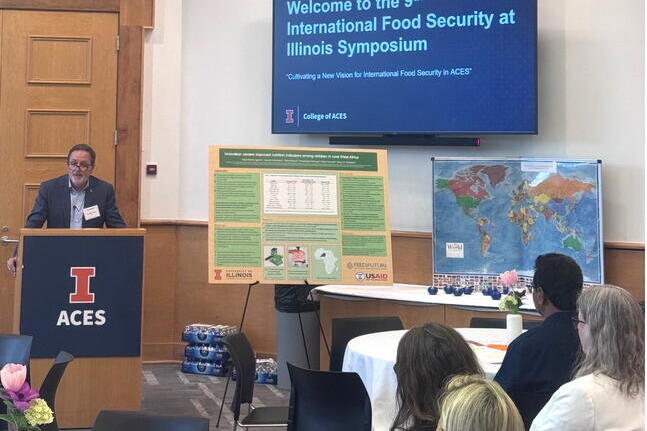
Students, faculty, and other stakeholders from the College of Agricultural, Consumer, and Environmental Sciences (ACES) gathered in April to strengthen the college’s focus on interdisciplinary work towards global food security.
“Food security is one challenge that touches every part of our college. From crop production and environmental systems to economics, nutrition, engineering, and community development — every department in ACES has expertise that contributes to this work,” noted Dean Germán Bollero as he opened the 9th Annual Food Security Symposium at Illinois.
The event on April 15-16 included a series of thematic panels spanning multiple disciplines, opportunities for students to showcase their work, and concluded with a participatory workshop for stakeholders to help shape the mission, vision, and priorities for future interdisciplinary work in global food security.
“This annual symposium has traditionally focused on a specific topic related to food security but this year we chose to look inward at the work we are already doing to reimagine how to best position ACES to be the most impactful moving forward,” explained Mary Arends-Kuenning, associate dean for international programs.
ACES students had an opportunity to showcase their own research towards food security; undergraduate students participated in a poster session, and graduate students participated in a lighting talks competition.
“The student sessions really emphasized the diversity of the work being done in ACES towards food security. Our undergraduates showed off their posters on topics ranging from school feeding programs in Cameroon and commercializing soybean varieties in Africa to detecting microplastics in eggs. Our graduate students also presented on a range of topics including global beef demand, using soil microbes to expand maize production, and how living with grandparents can help nutrition. They were all so impressive,” said Lauren Karplus, associate director for international programs who also organized the symposium.
Additional session topics included the circular bioeconomy, perennial grains, an African perspective on sustaining ethical and equitable collaborations, and dietary transitions. View the full program.
Finally, an interactive closing workshop helped participants move all that was showcased into a strategy for ACES to optimize its ongoing and future work to positively impact global food security.
“Some key takeaways included that Extension is very interested in being more involved internationally, and that although our college is already doing a lot of the needed work, we need to work a bit harder to make interdisciplinary connections among the college. The symposium also renewed ACES commitment to international work overall,” said Karplus.