When robots meet horseradish: A Ph.D. student’s mission toward sustainable solutions for small-scale farming
Illinois may be famous for being the Land of Lincoln and home of “Da Bears,” but few are familiar with one of its lesser claims to fame, which lies underground.
The commercial cultivation of horseradish in Southern Illinois took root in the 1850s, when German immigrant farmers discovered that the region’s sandy, nutrient-rich soil created an ideal environment for the unassuming crop to thrive.
Today, Illinois is recognized as one of the world’s leading suppliers of horseradish root. Despite this, the crop remains one of the few in the state that has seen minimal innovation in targeted agricultural technologies. That is where Sandesh Poudel comes in.
In the winter of 2025, Poudel joined Sunoj Shajahan’s Digital Precision Agriculture Lab in the Department of Agricultural and Biological Engineering, part of the College of Agricultural, Consumer and Environmental Sciences and The Grainger College of Engineering at the University of Illinois at Urbana-Champaign. With a master’s degree in agricultural engineering from the University of Georgia, Poudel’s doctoral research focuses on the integration of robotics, AI, and precision agriculture to develop sustainable solutions for farming systems. Upon his start at Illinois, he and Shajahan identified a unique opportunity to modernize farming for the state’s most pungent export.
“Robotics and automation have been a big driver in major commodity crops like corn,” Shajahan says. “But Illinois also leads in production for certain specialty crops, like horseradish and pumpkin. These specialty crops are often overlooked by big ag companies, and mechanization is close to zero.”
Recognizing this gap, Shajahan’s team sat down with local horseradish growers to assess their immediate needs. “Currently, horseradish farmers rely very heavily on manual labor for weeding, which is at a shortage in the United States,” Poudel explains.
Chemical herbicides, as it turns out, are also not an option. “Horseradish is a below-ground crop. With herbicide applications, there is a concern of contamination, so there are very limited chemical solutions to address weeds in horseradish.”
With limited labor and no chemical solutions, horseradish growers in Illinois turned to the Center for Digital Agriculture with a need for an autonomous solution to manage weeds in a crop that had seen very little technological progress. Their request aligned directly with the goals of the USDA-funded AIFARMS (Artificial Intelligence for Future Agricultural Resilience, Management, and Sustainability), whose technology adoption thrust focuses on turning real production challenges into new innovations.
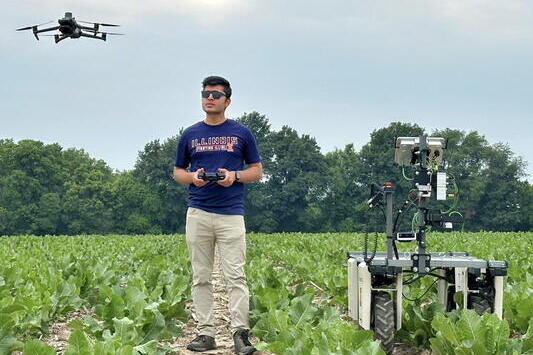
With support from AIFARMS, the project progressed quickly. Today, Poudel is leading research efforts to develop an autonomous robotic system for removing weeds in horseradish fields.