ACES and UNAM partner to enhance hydroponics with treated wastewater
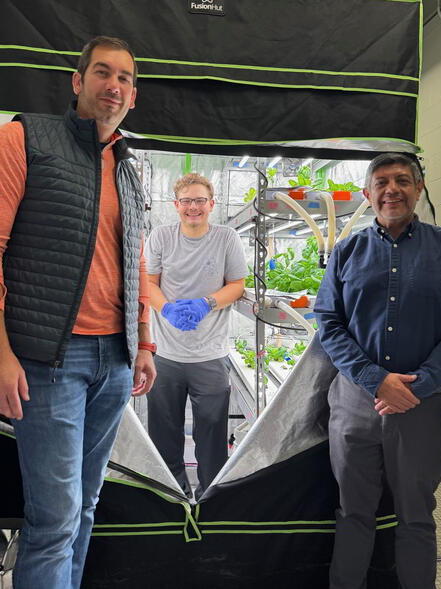
Building on its existing efforts towards more sustainable agriculture, the College of Agricultural, Consumer and Environmental Sciences is collaborating with the Universidad Nacional Autónoma de México (UNAM) to enhance hydroponic plant growth by using optimal nutrient solutions from treated wastewater.
Hydroponics–growing crops without soil–is becoming more popular due to the demand for locally grown and healthy food in all climates.
“Our existing hydroponic systems on campus can control temperature, humidity, and light. We have also been experimenting with using treated wastewater as a fertilizer source in these systems, and specifically the wastewater that comes from the hydrothermal liquefaction process that results from high temperature and high pressure being applied to the food waste,” said Paul Davidson, associate professor in the Department of Agricultural and Biological Engineering (ABE), part of the College of ACES and The Grainger College of Engineering at the U. of I.
Davidson is serving as the co-principal investigator on a joint research project with a group of researchers from the UNAM, who are also working on utilizing treated wastewater towards more sustainable agriculture. The new collaboration will offer insight into practices that could improve plant health and productivity under controlled yet resource limited settings.
Specifically the UNAM group is treating wastewater from a winery to create an amino acid compound called 5-Aminolevulinic acid (5-ALA).
“We’ve already found that the wastewater with 5-ALA can be used to promote plant growth, enhance plant tolerance to various stresses, and serve as a herbicide. So not only does the water get re-used but it actually adds value to the crops,” explained Germȧn Buitrón Méndez, professor at UNAM’s Laboratory for Research on Advanced Processes for Water Treatment at the Institute of Engineering, and Davidson’s co-principal investigator on the project.
Davidson’s group will also be adding 5-ALA to its processes.
“The combined expertise and overlap between our groups was obvious. We have been experimenting with wastewater for a few years and knew we had a gap, which maybe can be filled by 5-ALA, something we were not even previously considering,” said Davidson about the value of the new collaboration.
On the ACES side, the project allows for involvement of three graduate students and six undergraduate students who are all helping with the hydroponic growing and data collection of various plants including lettuce, broccoli, radish, and basil.
The ACES team is purchasing a purified 5-ALA to run the experiments because they aren’t allowed to transport the wastewater-derived 5-ALA across borders from UNAM, Davidson explained.
The two groups will run variations of similar experiments and will share data and results to come up with a joint hypothesis on how useful 5-ALA can be for enhancing plant growth. The first of several rounds of plants was just harvested, and data analysis has begun.
The study will compare the effects of two different water sources with commercially available and synthesized 5-ALA on both plant growth and water quality and ultimately offer information to close the loop of resources used.
The project is funded by a joint seed research grants program between the University of Illinois System and UNAM. Each institution invests an equal amount to fund its own principal investigators participating in the joint proposals selected by the joint review committee. A total of five joint projects around the themes of “food and health, water, or energy” were funded.
“The University of Illinois System and UNAM are committed to contributing towards solutions related to poverty, the environment, and sustainable well-being. This project is an excellent example of groups from each country coming together to advance valuable knowledge, which is exactly the purpose of the funding arrangement,” said Elvira de Mejia, Professor in the Department of Food Science and Human Nutrition and director of Illinois institutional relations with Mexico.