Genes from corn's wild ancestor change soil microbial community, improve sustainability
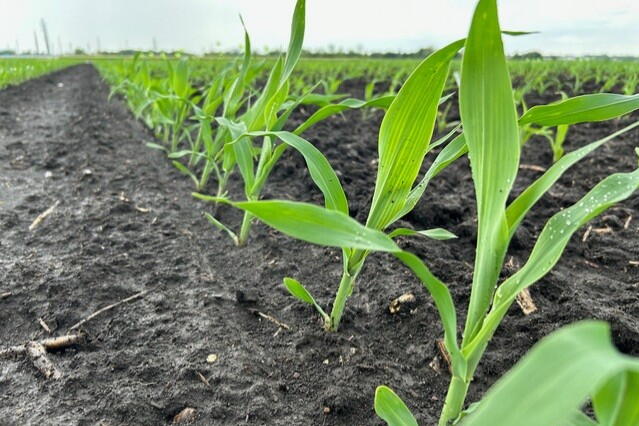
Corn bred with genes from wild relatives can reshape soil microbial communities and reduce nitrogen loss — with no yield reduction — according to new research from the University of Illinois Urbana-Champaign. The advancement marks the first time corn’s genetic makeup has been linked with inhibition of nitrifying and denitrifying bacteria, the microbes responsible for turning fertilizer nitrogen into forms that pollute water and contribute to climate change.
“We're already showing reductions in nitrification of up to 50% in field and greenhouse trials, which is awesome,” said the study’s senior author, Angela Kent, professor in the Department of Natural Resources and Environmental Sciences, part of the College of Agricultural, Consumer and Environmental Sciences at Illinois. “We grow 97.3 million acres of corn in the U.S. every year. If we were able to introduce that trait and reduce nitrification by 50% across that whole acreage, that would have huge impacts.”
Multiple groups of soil microbes use nitrogen as an energy source, but two of those groups are wildly overrepresented in modern agricultural soils, and both contribute to fertility loss. Nitrifying bacteria turn ammonium from organic matter or fertilizer into nitrate, a form of nitrogen that readily flows through soil to pollute waterways. Denitrifying bacteria convert nitrate into gaseous forms. Often, denitrifiers produce harmless dinitrogen gas, but when soil oxygen is abundant or soil carbon is limited — not uncommon conditions in conventional agriculture — denitrifiers produce nitrous oxide, a potent greenhouse gas.
The researchers say the Green Revolution and exclusive selection for aboveground traits in corn — ignoring traits related to the roots and rhizosphere, the microbe-rich zone surrounding roots — changed the crop’s relationship with the soil and created ideal conditions for nitrifiers and denitrifiers.
“During the Green Revolution, we started applying so much nitrogen fertilizer that corn didn't really need to compete with the microbes for nitrogen sources in the soil. There's more than enough nitrogen applied to our field to make nitrifiers, denitrifiers, and the corn happy,” said Alonso Favela, the study’s first author and an assistant professor at the University of Arizona. “But if we want to improve the sustainability of the system and lower the amount of nitrogen fertilizers we're applying to the field, traits that suppress nitrification and denitrification become really important.”
In a 2021 study, Favela and Kent found that those traits already exist in teosinte, corn’s wild and weedy ancestor. When teosinte activates specific genes, its roots release chemicals that inhibit the activity of nitrifiers and denitrifiers in the rhizosphere. This keeps soil nitrogen in the form of ammonium, which is more likely to stay in the field.
The Maize Genetics Cooperation Stock Center, part of the USDA’s taxpayer-funded National Plant Germplasm System and located at the U. of I., maintains a collection of near-isogenic lines (NILs) of a well-studied modern corn inbred line known as B73. Kent and Favela accessed NILs of B73 containing tiny fragments — or introgressions — of the teosinte genome to see if they could identify teosinte genes that inhibit nitrifiers and denitrifiers.
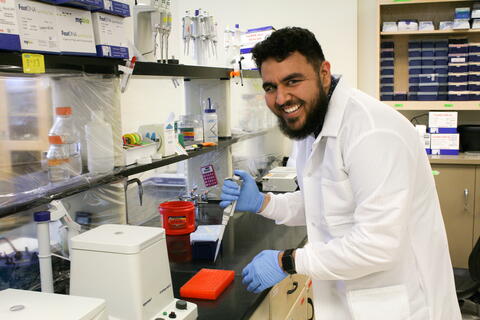
In a large field experiment, Favela grew B73, teosinte, and 42 NILs, each with a different snippet of the teosinte genome. At two points during the growing season, he took rhizosphere soil samples and analyzed the makeup of the microbial community.
That work revealed two NILs associated with nitrification inhibition, showing a 50% reduction in potential nitrification rates relative to B73. Two other NILs suppressed denitrification at similar rates, with dozens of others having at least some inhibitory effect on denitrification. Because each NIL contained only a small piece of the teosinte genome, the researchers could narrow down the candidate genes responsible for inhibition, a key step for future breeding programs. In controlled lab experiments, the team also confirmed these gene regions altered root chemistry, affecting nitrifying bacteria.
“There's a big movement towards thinking about microbiome traits as sort of an extended phenotype of the plant genome,” Kent said. “What’s really exciting is that we are breeding the plants, but for a trait that's expressed in the microbiome.”
Finally, acknowledging that microbial inhibition traits would be commercially challenged if they affected yield performance, the researchers crossed B73 and two nitrification-inhibiting NILs into hybrid corn backgrounds.
“Teosinte introgressions did not reduce yield,” Favela said. “The nitrification inhibition trait appears to be dominant, so that trait and yield were preserved regardless of the parent hybrid.”
Although these traits are not quite market-ready, the researchers are optimistic about the potential for ancient genes to reshape the future of agriculture.
“Agriculture remains the largest human impact on the global nitrogen cycle. Roughly 40% of applied nitrogen is lost from fields, even as many regions face nitrogen scarcity and food insecurity. This represents a waste of the energy used to create the fertilizer, as well as an environmental impact from nutrient pollution,” Kent said. “Harnessing nitrogen-conserving traits such as bacterial nitrification and denitrification inhibition represents both an environmental and humanitarian advance. The combination with maize genotypes that host nitrogen-fixing bacteria could create powerful synergies for sustainable production. This work highlights microbial ecology as a frontier for agronomic innovation and resource conservation.”
The study, “Lost and found: Rediscovering microbiome-associated phenotypes that reshape agricultural sustainability,” is published in Science Advances [DOI: 10.1126/sciadv.aed3360].
Research in the College of ACES is made possible in part by Hatch funding from USDA’s National Institute of Food and Agriculture. This study was also supported by a competitive NIFA grant (#ILLU-875-637), the Illinois Nutrient Research and Education Council (#NREC 2021-2-360190-334), a National Science Foundation Postdoctoral Fellowship (#220899), and the U.S. Department of Energy’s Center for Advanced Bioenergy and Bioproducts Innovation (#DE-SC0018420).
Kent is also affiliated with the Carl R. Woese Institute for Genomic Biology and the Program in Ecology, Evolution & Conservation Biology in the School of Integrative Biology, part of the College of Liberal Arts and Sciences at Illinois.