Illinois study: Can designer biochar pellets help manage phosphorus in agricultural fields?
Tile drainage is common in U.S. Midwest agricultural fields, helping to remove excess water and aerate the soil. While the practice enhances crop productivity, it can cause phosphorus to leak into nearby waterways, where it contributes to harmful algal blooms. Directing tile-drain runoff through a structure filled with biochar – a form of charcoal produced from organic waste – provides a potential remedy for phosphorus pollution, but the method is novel and not fully explored.
In a new study, University of Illinois Urbana-Champaign researchers examined the capacity of specially designed biochar pellets to absorb and release phosphorus under real-world conditions, finding they don’t perform as well as they do in laboratory settings.
“The idea was to find out if we can use designer biochar pellets to capture phosphorus from tile drains and later add the pellets to the field as a phosphorus nutrient amendment that reduces subsequent phosphate application,” said lead author Agnes Millimouno, a doctoral candidate in the Department of Agricultural and Biological Engineering, part of the College of Agricultural, Consumer and Environmental Sciences and The Grainger College of Engineering at the University of Illinois Urbana-Champaign.
The designer biochar pellets were made by mixing sawdust with bentonite clay and lime sludge, then heating and drying them to create a dense, carbon-rich material with a large surface area.
First, the pellets were placed at the outlet of a tile drain system in a field in Central Illinois for about a year. Then they were removed and dried for lab testing.
The researchers found that when the designer biochar pellets were exposed to a pure solution prepared in the lab, they absorbed the phosphorus as expected. But when the pellets were exposed to effluents from cow manure and other agricultural wastewater, they absorbed and released phosphorus in unpredictable ways.
Wastewater effluents, such as cow manure and other agricultural effluents, contain competing ions and other chemical elements and are rich in diverse microorganisms. This results in a more complex dynamic than pure phosphate solution, thereby reducing the performance of the designer biochar pellets in real-world applications.
“Agricultural effluents contain residues from pesticides, herbicides, metals, and biological components, and they are very reactive. The field is exposed to rain and other weather events, and the soil has a very complex composition. Our findings show that it is important to conduct experiments in a realistic setting that more closely mimics real-world conditions,” said co-author Jorge Guzman, research assistant professor in ABE.
The researchers measured pH, mineral salts, phosphorus, and dissolved organic carbon concentrations in the effluent.
Guzman noted that pH is particularly important in regulating sorption and desorption because it influences surface charge, ion concentrations, and mineral reactivity. The pH level affects how the biochar reacts, but the pellets can also affect pH and increase alkalinity, so it’s a dynamic process.
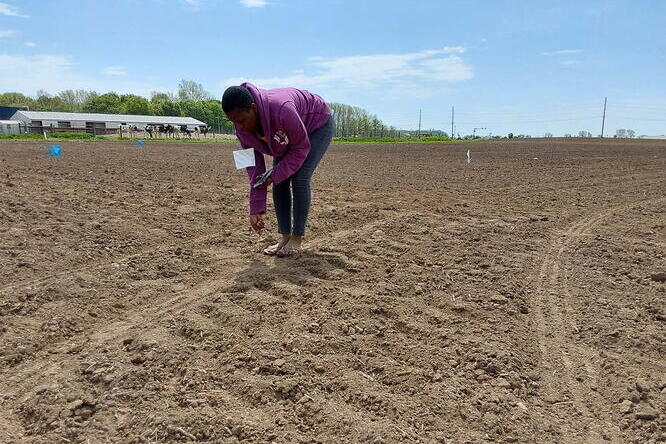
For the second part of the experiment, both new and used (spent) pellets were added to a cornfield research site in Central Illinois. The goal was to evaluate the capacity of the new pellets to absorb phosphorus and the spent pellets to release it into the soil. Again, the researchers found that pH dynamics were an important factor, and higher pH levels were associated with greater phosphate removal from soil solution, likely driven by phosphorus precipitation.
“Other studies have shown that biochar is efficient for removing nutrients in the field. But most of these studies are based on laboratory experiments that use a pure phosphate solution. When you use it in a real-world experiment, you have to consider the soil conditions. You also need to test existing phosphorus levels before applying the pellets,” Millimouno said.
Given the dual role of designer biochar pellets in sorption and desorption, assessing soil phosphorus levels prior to use is essential, she explained.
“We need long-term studies to see the potential effects of designer biochar pellets in the field. Understanding the interaction between biochar and phosphorus across soil types and conditions will be crucial in determining their efficacy in phosphorus management.”
The paper, “Evaluating Phosphorus Sorption and Desorption in Agricultural Wastewater Using Designer Biochar Pellets,” is published in Water Environment Research [DOI: 10.1002/wer.70349].
Research in the College of ACES is made possible in part by Hatch funding from USDA’s National Institute of Food and Agriculture. Additional funding was provided by the U.S. Environmental Protection Agency (EPA) under Grant Number 84008801.