New approach improves precipitation accuracy for hydrological models
Hydrological models represent water movement in natural systems, and they are important for water resource planning and management. But the models depend on reliable input data for weather factors, and precipitation can be very difficult to measure and represent accurately.
A new study from an international research team describes a novel method to better represent precipitation uncertainty in hydrological models, thereby improving their performance.
“Precipitation is very variable in space and time. There may be a single weather station collecting data in a large area, but turbulent wind can change measurements very fast across space. If you enter that information in the hydrological model as a single value, it can distort the model representation of rainfall for that area,” said co-author Jorge Guzman, research assistant professor in the Department of Agricultural and Biological Engineering, part of the College of Agricultural, Consumer and Environmental Sciences and The Grainger College of Engineering at the University of Illinois Urbana-Champaign.
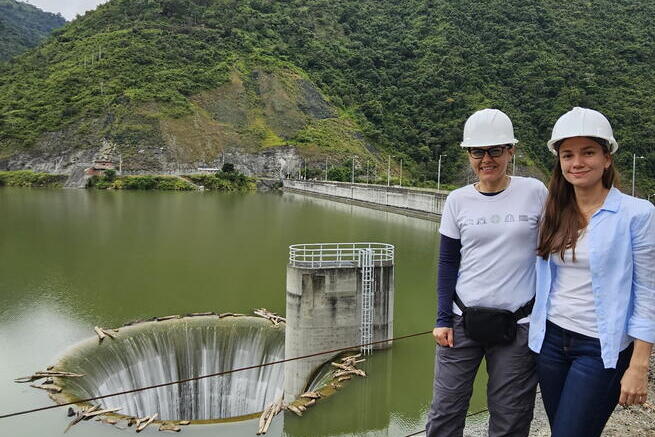
Guzman’s co-authors Dany Hernandez and Sandra Villamizar at the Universidad Industrial de Santander, Colombia, were studying the impact of land use changes on the Tona watershed, which is the main source of water for the metropolitan area of Bucaramanga in the northeastern part of Colombia.
They were using hydrological models to estimate sediment production and water yield in the watershed, but struggling with the representation of rainfall.
“Collecting precipitation data is a challenge if you do not have access to sophisticated weather stations. In Colombia, many places rely on manual readings, where a person goes out once or twice a day to collect the measurements, so precipitation data may not be very accurate,” Villamizar said.
She and Hernandez enlisted the help of Guzman and co-author Maria Chu, associate professor in ABE, to improve model calibration.
“The Colombian team had data from rainfall and streamflow in the Tona watershed. If there's a lot of precipitation, there should be a lot of discharge. We used that information to develop an algorithm that applies stepwise back correction to hydrological models. This helps to resolve discrepancies and improve the representation of precipitation,” Guzman said.
The researchers evaluated the accuracy of the framework at the Sangamon River watershed in central Illinois, as well as the Grande River watershed and the Jequitinhonha River watershed in Brazil, with assistance from co-authors Camila Ribeiro and Carlos de Mello at the Federal University of Lavras, Brazil.
These locations represented areas with different topographic characteristics, from the plains of Illinois to the mountainous regions in Brazil. Topography significantly influences rainfall spatial variability, which in turn affects soil erosion, drought and flood management, and hydraulic structures.
The research team tested their algorithm with three well-known hydrological models — the Soil and Water Assessment Tool (SWAT) in Illinois, and the Integrated Hydrological Modeling Software (MIKE-SHE) and the Distributed Hydrological Model (MHD) in Brazil.
They found improved performance for all three models, but SWAT showed the most consistent results with up to 18% higher accuracy than existing approaches. This underscores the impact of accounting for precipitation uncertainty in addition to traditional calibration, the researchers noted.
“This study addresses a common limitation in hydrological modeling by developing a structural analysis framework that integrates parameter calibration with dynamic precipitation correction, and the results show important improvements in performance metrics,” Hernandez said.
The research team has made their back-correction tool freely available to other researchers, who can access the software and application instructions online from the published paper.
The paper, “A stepwise back-correction function for precipitation representation in hydrologic models,” is published in Environmental Modelling & Software [DOI: 10.1016/j.envsoft.2026.106908].
Research in the College of ACES is made possible in part by Hatch funding from USDA’s National Institute of Food and Agriculture. This study was also supported by a grant from the Office of International Program in the College of ACES at Illinois and Grupo de Investigación en Recursos Hídricos y Saneamiento Ambiental, Civil Engineering Department, Universidad Industrial de Santander, Colombia.