Nature may benefit psychological well-being of disadvantaged children more than others
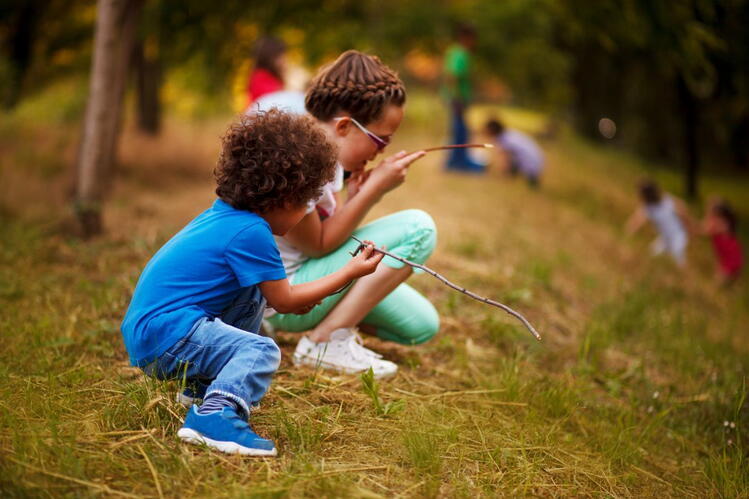
Growing up in disadvantaged communities can take a toll on children, with greater stress leading to mental health issues and delays in psychological development. But a decade’s worth of research suggests there’s an effective and nearly free remedy that may level the playing field with their advantaged counterparts: time in nature.
The concept, coined in 2013, is known as equigenesis. It refers to the ways in which a physical environment — usually the amount of greenspace in a neighborhood — can foster equity in health and functioning. According to the concept, people living with disadvantage, measured by factors like income, parental education, and minority status, may benefit more from natural environments than advantaged groups.
A new article from the University of Illinois Urbana-Champaign synthesizes what’s known about equigenic effects of greenspaces on the mental and psychological health of children living with disadvantage.
“Most of the equigenesis research has focused on physical health and adult populations — there have only been a couple dozen studies specifically looking at the differences in mental health impacts of greenspace on advantaged and disadvantaged children. We wanted to look holistically at this body of work to discover if any patterns emerged,” said Keira Denker, who led the review article after taking co-author Andrea Faber Taylor’s Children and Nature class as a senior in Psychology at Illinois.
Although hundreds of studies have shown clear benefits from time in greenspace, fewer have been designed specifically to compare disadvantaged and advantaged groups. Denker and Faber Taylor found 123 such studies, involving all ages and health metrics. Nearly 60% provided evidence of equigenesis. In other words, people living with disadvantage benefitted more from natural environments than their advantaged peers.
“That doesn’t mean advantaged groups don’t also benefit,” said Faber Taylor, teaching associate professor in the Department of Crop Sciences, part of the College of Agricultural, Consumer and Environmental Sciences at Illinois. “But there may be a ceiling effect; they already have the support needed and thus demonstrate less of a boost from time in greenspace in contrast to those living with disadvantage.”
Next, the team dove deeper into a subset of 24 studies that focused on children and their psychological health. Half of the studies clearly demonstrated greater benefits of greenspace for disadvantaged children, showing lower levels of anxiety, behavioral difficulties, and psychological and behavioral disorders, as well as improved reading and math skills, cognitive functioning, and prosocial and pro-environmental behaviors. A handful of studies had conflicting or non-significant results for equigenesis, but none suggested that time spent in greenspace was detrimental to either group.
Although the equigenesis field is still new, the researchers don’t see a downside in promoting more time in natural environments, especially for children living with disadvantage. Whether they’re specifically trying to prove equigenesis or not, study after study shows numerous psychological and mental health benefits of time in greenspace such as stress relief, attentional support, and reduced ADHD symptoms. That’s in addition to physical health benefits, from reduced cortisol and blood pressure to greater proliferation and activity of immune cells.
Denker and Faber Taylor acknowledge that greenspaces, such as city parks, may not be accessible or provide a safe environment for children in disadvantaged neighborhoods. While they believe in the reform and proliferation of neighborhood greenspaces, they urge administrators and policymakers to invest in school yard greening, which, they say, provides outsized returns.
“School yards in particular are low-hanging fruit,” Faber Taylor said. “Most children have to go to school, so they’d almost be guaranteed to experience that greenspace. There is some compelling work showing the value of green school yards in improving learning, especially math and science, and supporting movement and creative play. If you think about all the benefits of greenspace and the potential cost offsets for medical treatments or behavioral interventions, it's crazy not to just invest in more trees and other forms of greenspace.”
The study, “Nature is nurture: a scoping review of nature exposure as an equigenic intervention on children’s psychological health,” is published in Frontiers in Psychology [DOI: 10.3389/fpsyg.2026.1731222]. Denker graduated in May 2026, from the College of Liberal Arts and Sciences at Illinois.
Research in the College of ACES is made possible in part by Hatch funding from USDA’s National Institute of Food and Agriculture.