Management practices can enhance soil microbiome functions in plant defense
The soil microbiome is critical for the ecosystem, and agricultural practices that promote microbial diversity can support plant health and help protect against pests. But it is unclear which practices are most beneficial, and what motivates farmers to choose them.
In a new study, researchers from the University of Illinois Urbana-Champaign and Cornell University analyzed surveys and soil samples from 85 organic farmers in New York to investigate the interaction between beliefs, management practices, and soil microbiome functions.
“Our goal was to build a socio-ecological model that looks at how farmer beliefs about the soil microbiome mediate their management practices, and how those practices in turn affect ecological responses,” said lead author Elias Bloom, postdoctoral research associate at Cornell.
Co-authors on the study are Clare Casteel, associate professor in the School of Integrative Plant Science at Cornell, and Shadi Atallah, associate professor in the Department of Agricultural and Consumer Economics, part of the College of Agricultural, Consumer and Environmental Sciences at Illinois.
In a previous study, the researchers discussed how farmer beliefs about the microbiome affected their management practices. In this study, they combined information about practices with laboratory analysis of soil samples the farmers provided. They conducted DNA sequencing to determine which species of microbes were present in the soil samples and correlated this with the management practices the farmers reported using.
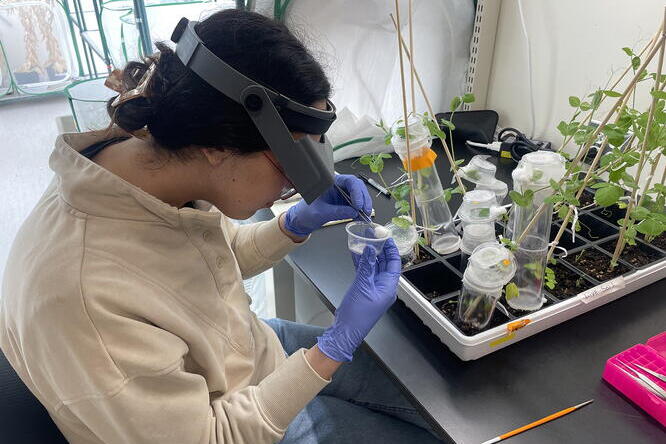
They also mixed microbiome extracts from the soil samples with potting soil and grew pea plants, then introduced aphids to the plants to evaluate their pest suppressing abilities.
“Conducting these experiments in the field is challenging because so many factors influence plant health. By bringing field soil into the lab, we're able to control these influences and focus on the soil microbiome, helping us build stronger evidence,” Casteel said.
The researchers linked three farming practices with microbiomes that strengthened plant defenses against pests.
Those were no tillage (farmers did not disturb the soil between plantings, or they used permanent, raised beds); cover crops, including cool and warm season grasses such as winter rye, sorghum, millet, and Sudan grass; and targeted drip irrigation or hand watering rather than broadcast irrigation.
One practice that negatively impacted the microbiome and the plants’ defensive abilities: the use of insecticides and pesticides within the last three years.
Finally, compost applications provided mixed results, depending on the starting condition of the microbiome.
“With this network of 85 farmers across the state, we're able to show that some practices have consistent impacts across wide geographic areas, while others are more context dependent,” Casteel said.
As expected, the researchers were able to correlate farmer beliefs about the microbiome with their preferred management practices.
“As economists, we typically survey farmers and ask whether they would adopt a practice given a hypothetical outcome. Here we had the opportunity to link the whole sequences from beliefs to practices to lab-measured microbiome outcomes to economic consequences. This is very novel and exciting,” Atallah said.
“We also typically focus on economic motives for management decisions, but we found that organic farmers’ beliefs about the impact of practices on the microbiome can matter more than economic factors in driving adoption,” he added.
The researchers are currently conducting another survey, giving farmers information on their soil’s microbiome and various options for cost-share payments to see how that affects their willingness to adopt soil microbiome-beneficial practices. The USDA Natural Resources Conservation Service offers cost-share programs for practices like no-till and cover crops. This ongoing study will shed light on how information on the soil microbiome can affect farmers’ demand for such conservation programs.
“Knowing that the acceptance of these practices and real microbiome outcomes are related to beliefs about the microbiome opens an opportunity for very targeted education and extension programming,” Atallah said.
The goal is to help farmers better understand the impact of different management strategies and guide them towards practices that can elevate natural forms of pest suppression, he added.
Ideally, farmers would be able to get individual recommendations based on their soil microbiome composition. However, there are substantial technological hurdles to overcome before a quick laboratory test is feasible. It is also necessary to gain a better understanding of the complexity of microbial composition. The researchers are working on creating biosensors that can be used to perform more rapid microbiome characterization, but these tools are still in development.
“It is important to keep in mind that pest suppression is just one function of the microbiome. There are still many unknown functions, and we don’t know which of these will be needed in the future as challenges in agriculture continue to arise, so it’s important to conserve microbial diversity,” Casteel said.
The paper, “Sustainable soil management practices are associated with increases in crop defense through soil microbiome changes,” is published in npj Sustainable Agriculture [DOI:10.1038/s44264-025-00109-6].
Research in the College of ACES is made possible in part by Hatch funding from USDA’s National Institute of Food and Agriculture. This work was also supported by a USDA AFRI Postdoctoral Fellowship and a NIFA-USDA Organic Transitions Program grant.